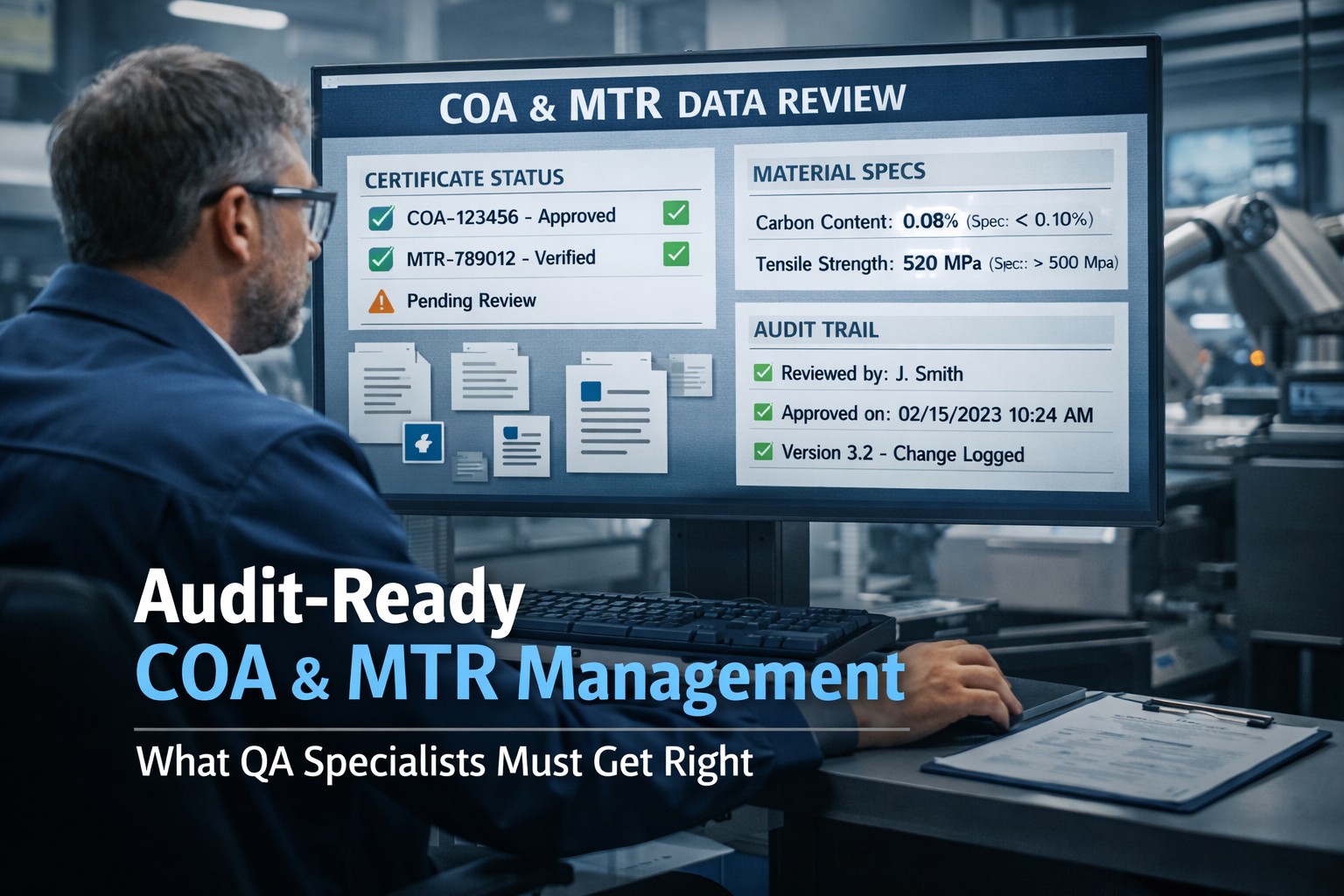
Quality audits rarely fail because of product defects alone. In most regulated industries, documentation gaps—especially around Certificates of Analysis (COAs) and Mill Test Reports (MTRs)—are what trigger non-conformances, observations, and warning letters.
For QA specialists, COA and MTR management has evolved from a clerical task into a high-risk quality function. Auditors across FDA, ISO 9001, AS9100, and IATF increasingly evaluate how well organizations control, validate, and trace supplier-provided quality data.
This guide explains what auditors expect today, supported by data points and real-world QA use cases.
Why COA & MTR Systems Are Under Audit Scrutiny
According to FDA enforcement trends and ISO audit reports, documentation-related deficiencies account for 30–40% of audit observations in regulated manufacturing environments. A significant share of these involve:
Incomplete or inconsistent supplier certificates
Manual transcription errors
Poor traceability between material, certificate, and production batch
Auditors no longer ask, “Do you have the COA?”
They ask, “Can you prove this COA was reviewed, verified, approved, and applied correctly?”
FDA: Data Integrity and Controlled Review
For FDA-regulated industries (pharma, biotech, medical devices), COAs fall squarely under data integrity requirements.
What FDA Auditors Verify
Document authenticity: COAs must be original, complete, and attributable to verified suppliers.
Controlled QA review: Named reviewers, date/time stamps, and documented approval workflows.
ALCOA+ compliance: Data must be accurate, complete, consistent, and enduring.
Electronic controls: Audit trails, role-based access, and change history for digitized COAs.
Real QA Use Case
A mid-sized pharmaceutical manufacturer received an FDA 483 because QA staff manually copied assay values from supplier COAs into a LIMS system. A single transcription error went undetected and impacted multiple batches.
Root cause: No system-level validation between COA values and specification limits.
Lesson for QA: Manual re-entry of COA data is now treated as a data integrity risk, not a minor inefficiency.
ISO 9001: Process Consistency Over Individual Judgment
ISO 9001 auditors focus less on regulation and more on repeatable, controlled processes.
What ISO Auditors Expect
Documented procedures for COA/MTR receipt, review, and acceptance
Defined acceptance criteria linked to specifications
Risk-based differentiation (critical vs non-critical materials)
Fast retrieval of historical records during audits
Data Insight
ISO audit bodies report that inconsistent QA review practices across sites are among the top causes of minor and major non-conformances.
Real QA Use Case
A global chemicals company passed audits at one plant but failed at another. Investigation showed each site used different informal rules to review COAs.
Result: Non-conformance due to lack of standardized control.
Lesson for QA: Auditors assess the system, not individual competence.
AS9100: Traceability Is Binary—You Have It or You Don’t
In aerospace and defense, AS9100 audits are uncompromising. A missing link in traceability can invalidate entire material lots.
What AS9100 Auditors Check
End-to-end traceability: supplier → heat/batch → part → delivery
Alignment with current engineering specifications
Long-term document retention (often decades)
Controls against counterfeit or altered certificates
Real QA Use Case
An aerospace supplier failed an AS9100 audit when auditors found that heat numbers on MTRs were not digitally linked to finished parts. QA relied on spreadsheet cross-references.
Impact: Immediate suspension of approvals until corrective actions were implemented.
Lesson for QA: Manual traceability methods do not scale—and auditors know it.
IATF 16949: COAs as Tools for Defect Prevention
IATF auditors view COAs and MTRs as active quality inputs, not passive records.
What IATF Auditors Expect
Integration with incoming inspection decisions
Defined reaction plans for missing or non-conforming COAs
Supplier performance tracking using COA deviations
Standardized rules across plants and programs
Industry Data
Automotive OEMs report that supplier documentation errors contribute to up to 20% of incoming material holds, delaying production and increasing cost.
Real QA Use Case
A Tier-1 automotive supplier repeatedly accepted late COAs without escalation. During audit, QA could not show corrective actions linked to recurring documentation issues.
Finding: Failure to use COA data for supplier quality improvement.
Lesson for QA: Reviewing a COA is not enough—acting on its data is mandatory.
Common Audit Findings Across All Standards
Regardless of framework, auditors consistently flag:
Manual data transcription without validation
Missing or undocumented QA approvals
Poor linkage between certificates and material lots
Outdated specifications used during review
Inability to retrieve documents quickly during audits
Organizations that rely on emails, shared drives, or PDFs alone are increasingly exposed.
What Audit-Ready COA & MTR Systems Look Like
Audit-ready QA teams typically operate with:
Structured extraction of COA/MTR data (not free-text PDFs)
Rule-based validation against specs and tolerances
Role-based review and approval workflows
Full traceability across suppliers, lots, and batches
Searchable, audit-ready repositories retrievable in minutes
Even when automation is not explicitly required by regulation, auditors now expect digital control and evidence.
Final Perspective for QA Specialists
COA and MTR management is no longer a back-office activity. It is a front-line quality risk function with direct impact on compliance, recalls, and customer trust.
QA teams that treat certificates as static documents often discover gaps during audits. Those that treat them as controlled quality data are consistently audit-ready.