In the U.S. metals industry, Days Sales Outstanding (DSO)—the average number of days it takes a company to collect payment after a sale—is a vital cash flow indicator. The higher the DSO, the longer cash remains trapped in the system, delaying investments in raw material purchases, equipment upgrades, or strategic inventory. With commodity prices swinging sharply and demand cycles often unpredictable, reducing DSO is no longer just an accounting goal—it’s a competitive necessity.
Increasingly, mills, service centers, and fabrication shops are turning to artificial intelligence in Accounts Payable (AP) automation to cut DSO by double digits. The breakthrough? Payments are accelerated not by pushing customers harder, but by eliminating the operational bottlenecks that delay invoice approvals and dispute resolution.
The Cash Flow Challenge in Metals
The metals supply chain is documentation-heavy. Purchase orders, mill test reports (MTRs), bills of lading (BOLs), and quality certificates all have to align before an invoice is approved. A missing heat number, a mismatch in alloy grade, or an incorrect freight charge can stall payments for weeks.
Industry benchmarks show that in U.S. manufacturing, average DSO sits at 45–50 days. In metals—especially in multi-plant enterprises—it can exceed 60 days when document verification is manual and fragmented.
How AI Accelerates the Payment Cycle
1. Instant Document Matching
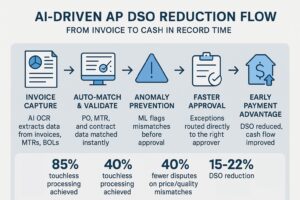
AI-powered AP platforms can extract and process data from invoices, MTRs, and BOLs—regardless of layout—and match them against purchase orders in seconds.
Example: A Midwest steel service center implemented AI OCR combined with large language models (LLMs) to achieve 85% touchless document matching, cutting approval time from 7 days to 2 days.
2. Automated Dispute Prevention
Machine learning models proactively detect discrepancies—such as out-of-spec metal grades or missing freight details—before invoices reach approval queues, avoiding costly back-and-forth.
Example: An aluminum extrusions manufacturer reduced price variance disputes by 40% through AI-based contract and index price validations.
3. Supplier Portal Intelligence
AI-powered virtual assistants embedded in supplier portals can instantly answer “Where’s my payment?” queries, provide live payment status, and pre-empt escalation calls—shortening the reconciliation cycle.
Case Studies: Double-Digit DSO Reduction
Steel Coil Processor – DSO dropped from 54 to 42 days in six months, a 22% reduction, by automating AP workflows end-to-end.
Fabrication Shop Chain – Linked AI AP automation with ERP, MES, and LME/COMEX price feeds, reducing DSO by 15 days while cutting exceptions by 35%.
Why This Matters Now
In a market where steel and aluminum prices can fluctuate by up to 20% in a single quarter, freeing up cash faster provides a decisive advantage. A 10-day DSO reduction on $50M annual revenue can release more than $1.3M in working capital—capital that can be reinvested in hedging strategies, bulk material buys, or automation upgrades.
The Future: Predictive Payables
The next evolution of AI in AP won’t just be about faster processing. Predictive models will forecast which customers are likely to delay payments, simulate the impact of altering payment terms, and recommend when to offer early-payment discounts to maximize cash flow.
AI is transforming AP from a back-office cost center into a strategic cash flow accelerator for metals companies. By cutting DSO by double digits, the technology isn’t just improving balance sheets—it’s helping the industry build resilience in a volatile market.