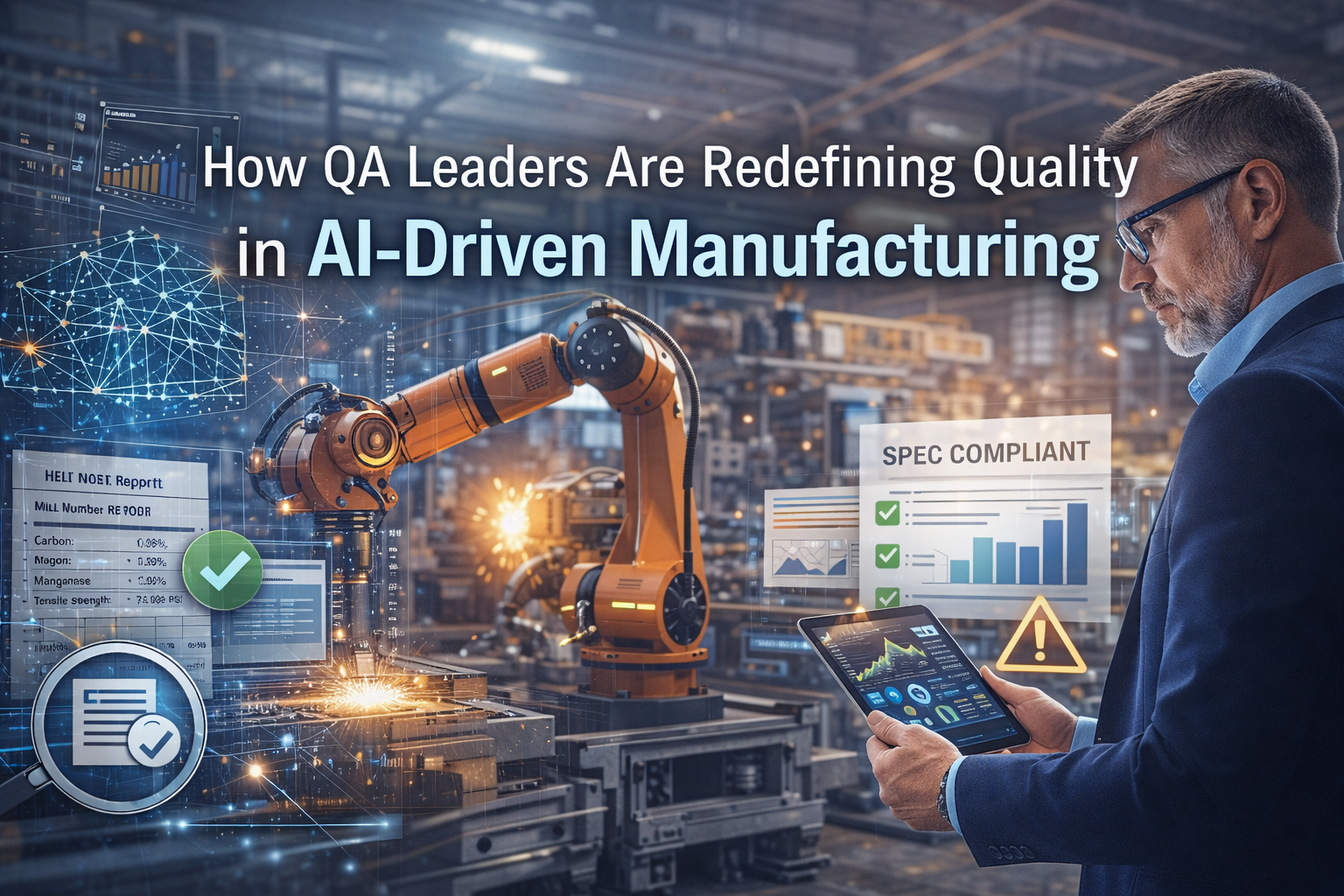
For decades, “quality” in manufacturing was defined by inspection outcomes—pass or fail, compliant or non-compliant. In 2026, that definition no longer holds. As AI-driven systems reshape production, supply chains, and compliance expectations, Quality Assurance (QA) leaders are redefining quality as control, predictability, and evidence integrity.
This shift is not driven by technology enthusiasm, but by operational reality.
From Inspection to Intelligence
Traditional QA focused on detecting defects after they occurred. AI-enabled manufacturing flips this model. Today’s QA leaders prioritize early detection, pattern recognition, and predictive risk signals.
AI-powered QA systems analyze inspection data, supplier certificates, machine outputs, and historical deviations to identify trends long before failures surface. Quality is no longer a checkpoint—it is a continuous intelligence layer embedded into operations.
Quality as Evidence, Not Documentation
In 2026, auditors and regulators care less about whether documents exist and more about whether evidence is governed. QA leaders are redefining quality around data integrity, traceability, and audit defensibility.
AI-driven QA automation ensures:
Every quality record is traceable to source
Every decision has a system-backed rationale
Every approval is logged, versioned, and immutable
Quality is no longer “managed” in inboxes and spreadsheets—it is controlled within systems.
Supplier Quality Moves to the Center
As manufacturing ecosystems expand globally, QA leaders are shifting focus upstream. Supplier-generated data—COAs, MTRs, inspection reports—represents the largest quality risk surface.
AI helps QA teams:
Detect recurring supplier deviations
Flag inconsistent formatting or missing data
Score suppliers based on quality reliability, not just cost
In 2026, supplier quality is no longer reactive firefighting. It is a measurable, automated control mechanism.
Speed Without Compromising Control
One misconception about AI in QA is that it prioritizes speed over rigor. In practice, the opposite is true. QA leaders are leveraging AI to standardize decision-making, reduce manual intervention, and eliminate subjective judgments.
Automation enables faster approvals—but within clearly defined rules, thresholds, and compliance frameworks. Quality improves not because teams move faster, but because systems remove variability.
Quality as a Business Enabler
Perhaps the most significant redefinition is organizational. QA leaders in 2026 are no longer seen as gatekeepers slowing production. They are risk managers enabling scale.
AI-driven quality systems help organizations:
Accelerate supplier onboarding
Reduce audit observations
Prevent shipment delays
Protect revenue during demand surges
Quality becomes a strategic asset—not a compliance burden.
The New Definition of Quality in 2026
For QA leaders, quality in an AI-driven manufacturing era means:
Predictive, not reactive
System-governed, not person-dependent
Evidence-driven, not document-heavy
Embedded into operations, not layered on top
In 2026, quality is no longer about catching errors.
It is about proving control—at scale.