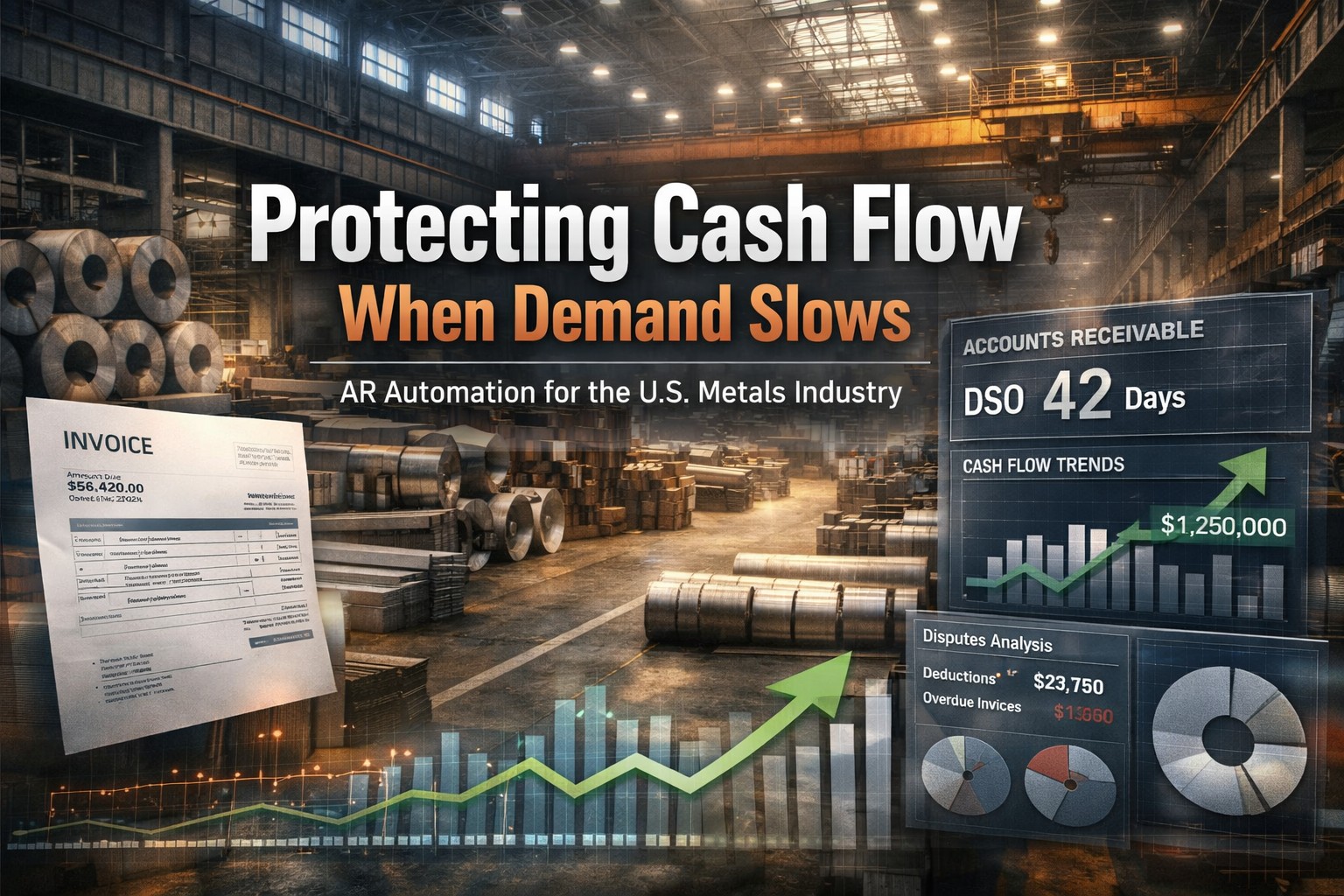
Demand cycles in the U.S. metals market are unforgiving. When construction pauses, automotive orders soften, or infrastructure projects slow, the impact is felt immediately—not just on order books, but on cash flow. During these periods, the weakest link is rarely sales. It is Accounts Receivable.
For many U.S. metal manufacturers and service centers, AR processes are still heavily manual—dependent on spreadsheets, emails, and fragmented ERP workflows. In a slowdown, this model quietly amplifies risk.
When Demand Slows, Cash Discipline Matters More Than Revenue
In high-demand cycles, delayed invoices, unresolved disputes, and slow collections are often masked by volume. Cash keeps coming in despite inefficiencies. But when demand tightens, every unpaid invoice becomes visible on the balance sheet.
Metal companies face unique AR challenges:
Pricing tied to weight, grade, and heat numbers
Frequent freight and fuel surcharges
Short pays due to specification or documentation mismatches
High dispute volumes from OEMs and distributors
During slowdowns, customers become more aggressive in scrutinizing invoices. Minor discrepancies that once passed now trigger payment holds. Manual AR teams struggle to keep up.
AR Automation Shifts AR from Reactive to Preventive
AR automation fundamentally changes how cash is protected—not by chasing payments harder, but by preventing delays in the first place.
Automated AR systems ensure invoices are:
Generated faster after shipment
Matched automatically with POs, BOLs, contracts, and quality documents
Validated for pricing, freight, and quantity accuracy before dispatch
This reduces the number of “defective invoices” entering the customer’s AP system—one of the biggest causes of delayed payments in the metals sector.
Faster Dispute Resolution Preserves Liquidity
In downturns, unresolved disputes become cash traps. A single pricing or freight discrepancy can hold up hundreds of thousands of dollars.
AR automation enables:
Automated identification of short pays and deductions
Categorization of disputes by root cause (price variance, freight, quality, quantity)
Faster collaboration between finance, sales, logistics, and quality teams
Instead of disputes sitting in inboxes for weeks, they move through structured workflows with accountability and visibility.
Real-Time DSO Visibility Enables Early Intervention
During demand slowdowns, Days Sales Outstanding (DSO) is one of the earliest indicators of financial stress.
Manual AR reporting often lags reality. By the time DSO deterioration is visible, cash gaps have already formed.
AR automation provides:
Real-time DSO tracking by customer, region, and product line
Early warning signals on customers extending payment behavior
Data-backed prioritization of collection efforts
This allows finance leaders to intervene before payment delays become systemic.
Protecting Cash Without Damaging Customer Relationships
Aggressive collections during downturns can strain long-term customer relationships—especially in the tightly networked U.S. metals ecosystem.
Automation enables a more professional, data-driven approach:
Accurate invoices reduce friction
Clear documentation speeds approvals on the customer side
Structured communication replaces ad-hoc follow-ups
Customers pay faster not because they are pressured—but because it is easier to pay correctly.
AR Automation as a Downcycle Survival Tool
Historically, metal companies that survive downturns are not always the ones with the strongest order books—but the ones with the tightest cash control.
AR automation helps organizations:
Stabilize cash inflows during demand volatility
Reduce dependency on credit lines
Improve forecasting accuracy for leadership decisions
In slow markets, protecting cash is protecting the business.
——————————————————————–
Demand slowdowns in the U.S. metals market are inevitable. Cash flow crises don’t have to be.
AR automation transforms Accounts Receivable from a back-office function into a frontline defense—ensuring that even when volumes decline, liquidity remains predictable, controlled, and resilient.
Because in metals, surviving the cycle is as important as winning the next one.