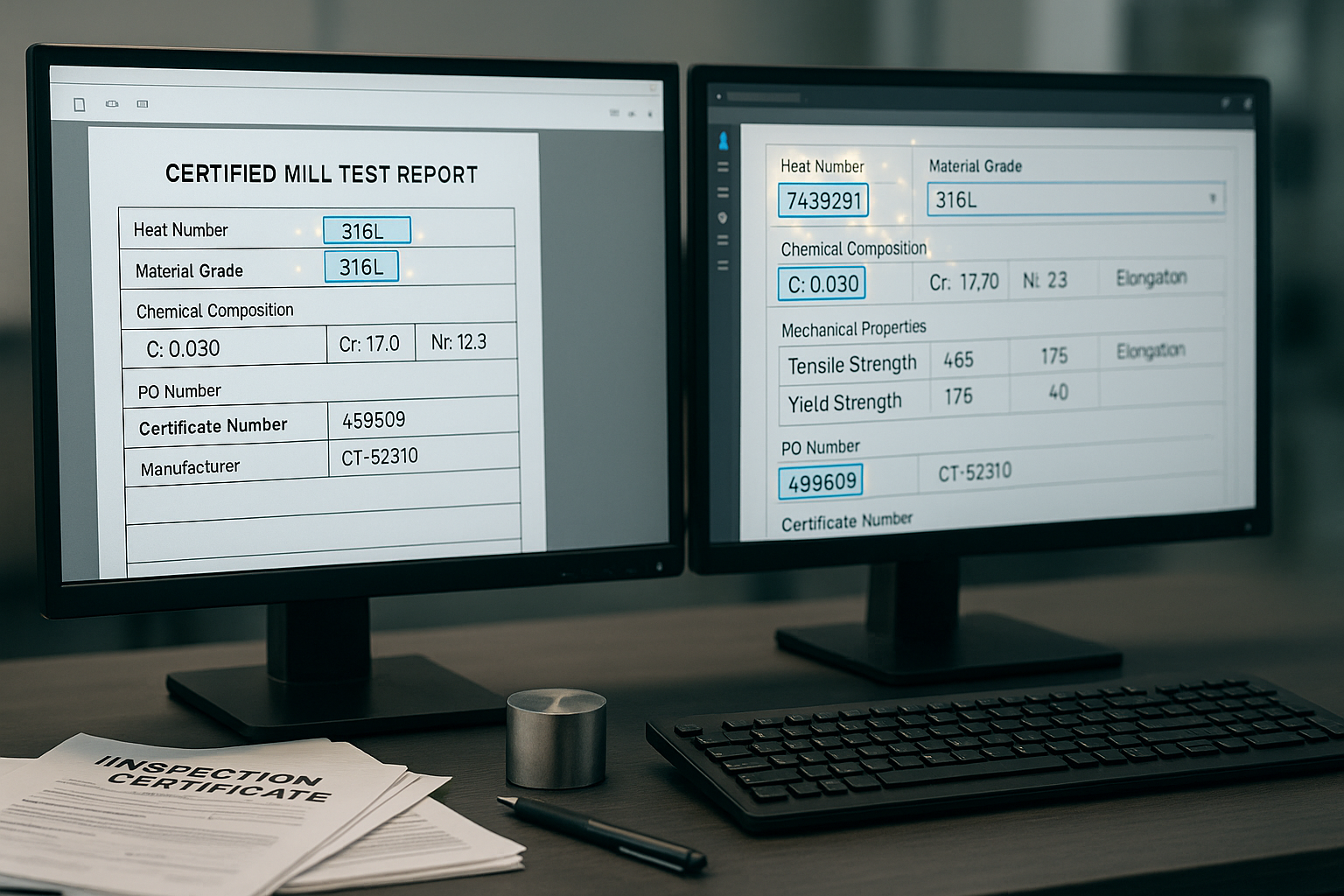
Traceability has become the new quality benchmark for the metals industry. Whether it’s stainless steel tubing for medical use or alloy plates for structural fabrication, every component is expected to come with complete, verifiable documentation — specifically, a Mill Test Report (MTR) that certifies its chemical and mechanical properties.
Yet, despite this growing compliance requirement, many metal service centers and processors still rely on manual typing to extract critical MTR details like heat number, grade, certificate number, and chemical composition from PDF or scanned documents. This traditional process is slow, error-prone, and increasingly unsustainable in an era of digital-first operations.
That’s where Hybrid OCR + AI is changing the game.
The Evolution of MTR Capture
Traditional Optical Character Recognition (OCR) systems were built to read — not to understand. They could convert a scanned certificate into editable text, but struggled with inconsistent layouts, varied supplier templates, and handwritten or low-quality scans. As a result, human operators still had to clean, cross-check, and type data into ERP or quality systems.
Hybrid OCR + AI, however, goes beyond optical recognition. It reads and interprets.
By combining the visual accuracy of OCR with the contextual intelligence of AI models trained on metallurgical documents, this approach can automatically detect and categorize key data fields, including:
Heat number
Material grade and specification
Chemical composition (element-wise values)
Mechanical properties (tensile strength, yield strength, elongation)
Purchase order or line item details
Certificate number and date
Manufacturer or mill information
Each extracted value is validated in real-time against predefined patterns, units, or tolerance thresholds — creating a structured, verified dataset ready for downstream use.
Speed and Accuracy
The biggest transformation lies in processing speed and data accuracy.
Manual typing typically takes several minutes per document — and a mid-sized distributor might process hundreds of MTRs every day. Even with trained staff, fatigue and formatting inconsistencies can lead to misentries that compromise traceability. Hybrid OCR + AI, on the other hand, can process an MTR in under 10 seconds, with accuracy rates exceeding 99% when tuned to domain-specific templates.
This translates to measurable operational gains:
Faster document turnaround – Immediate data availability accelerates order fulfilment.
Improved traceability – Every heat number and property is correctly linked to its corresponding material batch.
Reduced human error – AI validation ensures consistency across thousands of records.
Better audit readiness – Structured data simplifies compliance checks during customer or regulatory audits.
Traceability as a Compliance Imperative
In sectors like aerospace, energy, and automotive, traceability is not optional — it’s mandated. A single mismatch between a material property on an MTR and the one logged in a production record can trigger rework, shipment holds, or costly recalls. Hybrid OCR + AI eliminates these weak links by ensuring that the data extracted from a certificate is exactly what enters the system, leaving an auditable digital trail.
This is particularly valuable during material non-conformance investigations. Instead of manually searching through folders of PDFs, quality engineers can instantly retrieve all MTRs linked to a specific heat number or specification and verify their source accuracy.
The Business Case for Automation
While compliance remains the primary driver, the business case for AI-driven MTR capture is equally strong.
By reducing manual work, organizations can redirect skilled staff from repetitive data entry to higher-value tasks like vendor evaluation, process improvement, and customer engagement.
Moreover, when structured MTR data integrates with ERP or MES systems, it enables advanced analytics — helping identify supplier trends, detect recurring material issues, and optimize purchasing based on historical property performance.
What was once a back-office task now becomes a strategic data asset.
As the metals industry continues to digitize, traceability compliance will evolve into a competitive differentiator. Customers increasingly expect end-to-end transparency — from heat number to shipment label — and regulators are tightening quality documentation standards across geographies.
Organizations that continue to depend on manual MTR typing will find it difficult to keep pace with modern quality assurance frameworks. Those adopting hybrid OCR + AI will gain not only efficiency but also data integrity, audit confidence, and faster responsiveness — the cornerstones of digital trust.
Hybrid OCR + AI is more than just a smarter way to read MTRs — it’s a fundamental shift toward data-driven traceability.
By uniting high-speed capture with machine-level accuracy, it removes one of the last manual bottlenecks in metals documentation. The result is clear: fewer errors, faster compliance, and a stronger foundation for intelligent manufacturing.