In the manufacturing industry, efficiency is a direct driver of profitability. From raw material sourcing to distribution, manufacturers deal with thousands of documents every month—purchase orders, invoices, compliance certificates, quality reports, shipping notes, and more. Traditional manual document handling not only slows operations but also increases the risk of errors and compliance failures.
This is where Intelligent Document Processing (IDP) steps in. By combining AI, OCR, and machine learning, IDP enables organizations to automatically extract, validate, and integrate data from both structured and unstructured documents into their enterprise systems. But which departments in a manufacturing enterprise gain the most from IDP adoption? Let’s explore the critical areas.
1. Procurement & Supply Chain Management
Key Documents: Purchase orders, vendor invoices, contracts, delivery notes
Procurement departments constantly interact with suppliers, managing contracts, validating delivery notes, and processing purchase orders. Manual handling of these documents often leads to delays, duplicate entries, and mismatches.
How IDP Helps:
Automatically extracts and validates vendor details, quantities, and pricing from POs and invoices.
Integrates directly into ERP systems for faster approvals and payments.
Enhances supplier relationship management by reducing disputes caused by data errors.
Impact: Reduced cycle times for procurement, improved supplier trust, and streamlined supply chain visibility.
2. Finance & Accounts Payable
Key Documents: Vendor invoices, payment receipts, credit notes
The finance department in manufacturing deals with bulk invoices and complex payment reconciliations, often across multiple vendors and geographies. Manual AP processes result in delayed payments, missed discounts, and strained vendor relations.
How IDP Helps:
Automates invoice capture, validation, and posting into financial systems.
Identifies discrepancies between purchase orders, invoices, and goods received notes (3-way matching).
Speeds up approval workflows, ensuring timely payments and cash flow optimization.
Impact: Lower operational costs, fewer late payment penalties, and higher accuracy in financial reporting.
3. Quality & Compliance
Key Documents: Mill test reports (MTRs), Certificates of Analysis (CoA), safety compliance records, ISO audit documents
Quality assurance and compliance are non-negotiable in manufacturing. Document-heavy processes like verifying product specifications, safety certificates, and compliance with environmental standards are critical. Manual handling increases risks of non-compliance, fines, or even production halts.
How IDP Helps:
Extracts key data from MTRs, CoAs, and compliance certificates automatically.
Standardizes documents from multiple suppliers for easy comparison.
Flags anomalies or missing compliance details before materials enter production.
Impact: Higher accuracy in compliance reporting, reduced risk of penalties, and improved audit readiness.
4. Human Resources (HR)
Key Documents: Employee records, training certifications, shift rosters, recruitment forms
Manufacturing companies often employ large workforces, including contractors and temporary staff. Managing onboarding documents, certifications, and compliance records can be a daunting task when done manually.
How IDP Helps:
Digitizes and classifies resumes, application forms, and onboarding documents.
Ensures employee training and certification records are validated and up to date.
Automates shift scheduling documentation and compliance audits.
Impact: Faster recruitment cycles, reduced paperwork, and better workforce compliance tracking.
5. Logistics & Distribution
Key Documents: Bills of lading, shipping invoices, customs declarations, delivery receipts
Manufacturers must ensure raw materials arrive on time and finished goods reach customers seamlessly. Logistics teams often struggle with paperwork-heavy processes involving customs, transportation, and warehouse documentation.
How IDP Helps:
Automates data extraction from bills of lading and customs documents.
Integrates logistics data with ERP for real-time tracking.
Reduces manual data entry errors in shipment and delivery documents.
Impact: Improved visibility across logistics, faster turnaround at checkpoints, and enhanced customer satisfaction.
6. Research & Development (R&D)
Key Documents: Lab reports, patent filings, product test results, regulatory submissions
Innovation in manufacturing depends on structured documentation of experiments, test results, and compliance with safety and regulatory standards. Manual data entry in R&D not only slows innovation but can also lead to costly mistakes.
How IDP Helps:
Digitizes and organizes lab reports and test data for easy retrieval.
Automates extraction from regulatory guidelines for faster compliance alignment.
Ensures accurate documentation in patent filings and product certifications.
Impact: Faster product development cycles and reduced risk of regulatory non-compliance.
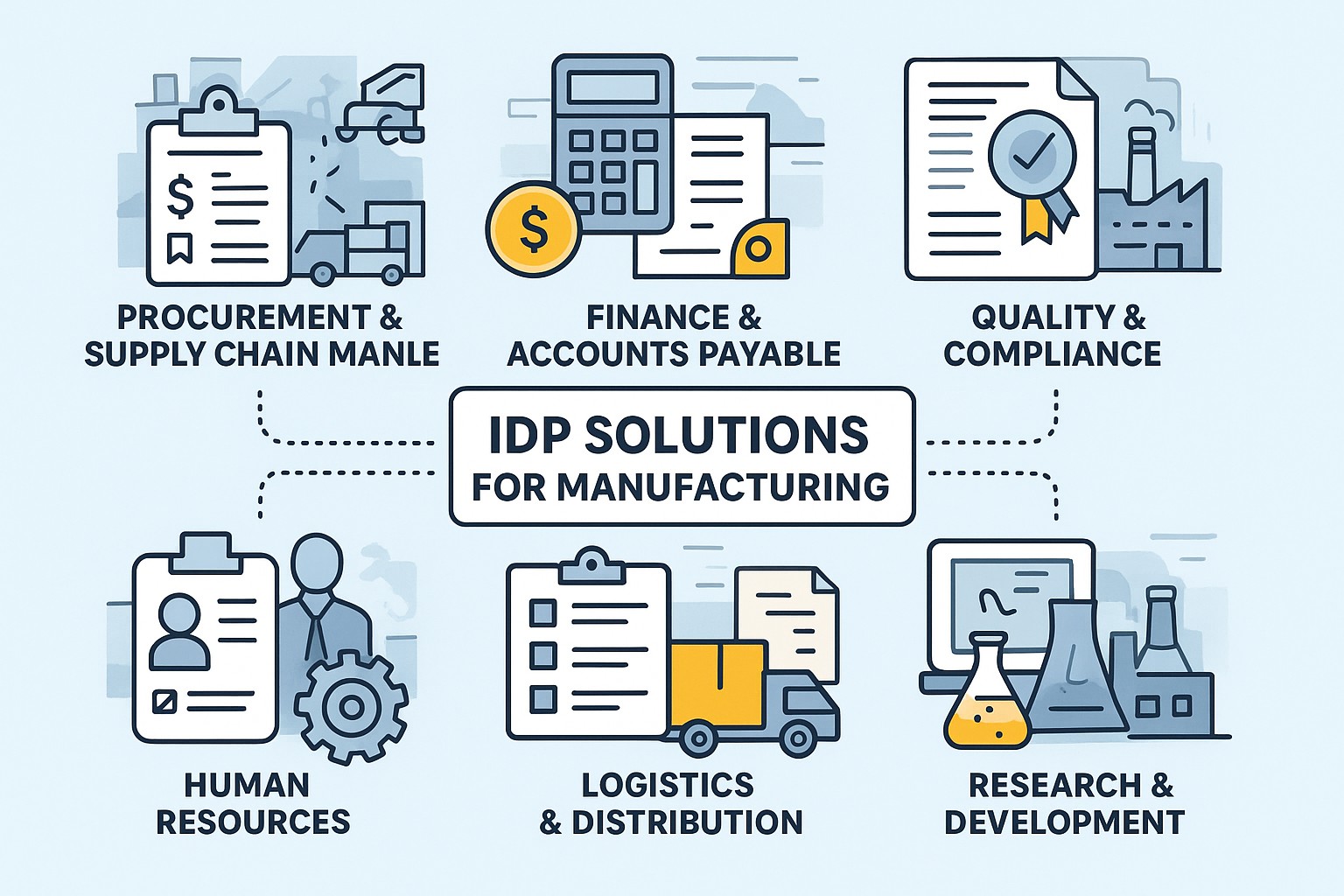
The manufacturing industry thrives on precision, efficiency, and compliance. By adopting Intelligent Document Processing solutions, manufacturers can modernize their document-heavy workflows across procurement, finance, compliance, HR, logistics, and R&D. The result is not just cost savings but also faster decision-making, improved accuracy, and stronger resilience in supply chains.
In an era of Industry 4.0, embracing automation through IDP is no longer optional—it’s a competitive necessity.