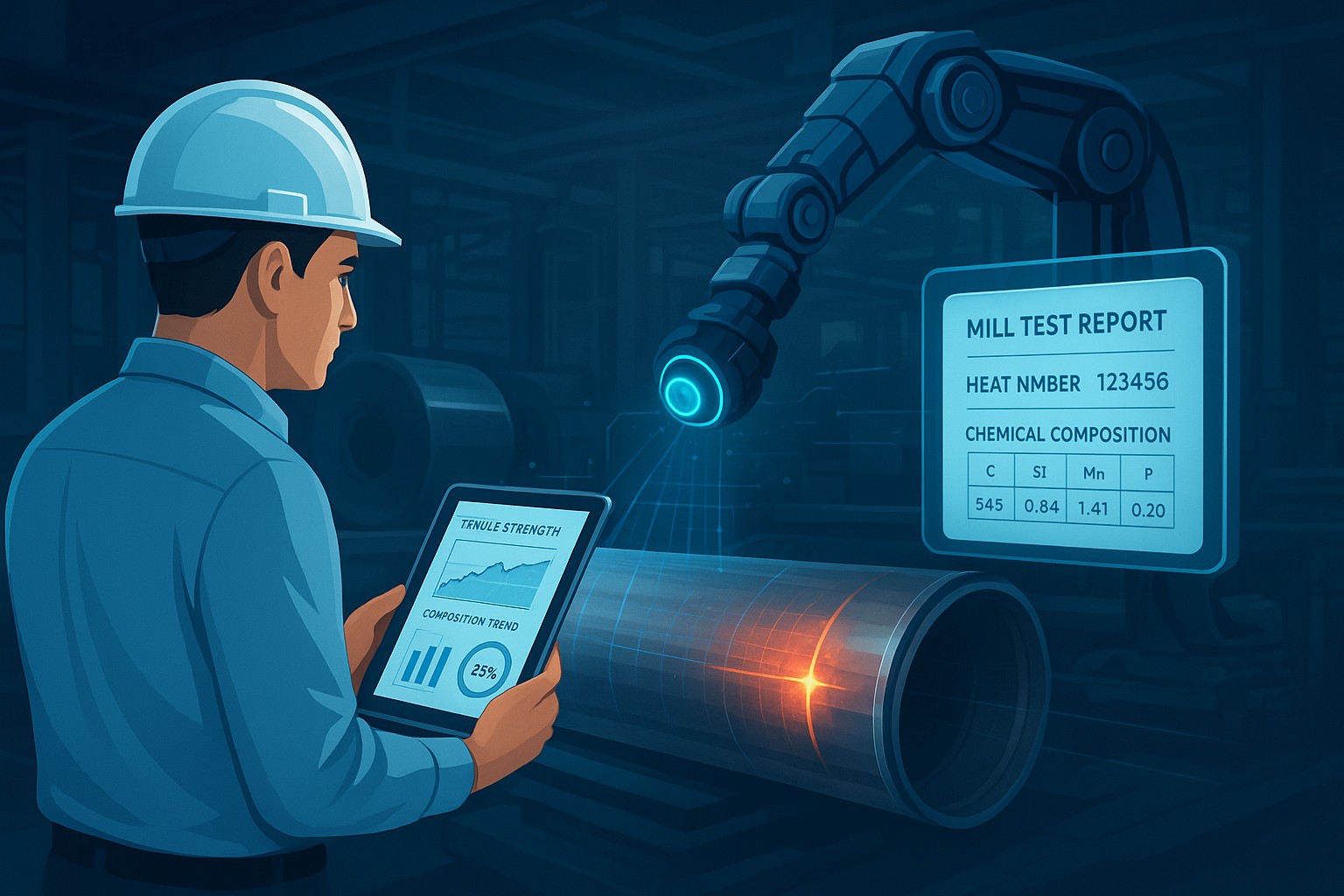
Material Test Reports (MTRs) have long served as essential documents that certify a material’s mechanical and chemical properties. Traditionally, MTRs have been viewed as compliance paperwork—used to confirm a product meets ASTM, ASME, or ISO standards. But that perception is rapidly changing.
With AI-driven MTR automation, manufacturers are unlocking the next frontier: predictive analytics. Instead of merely extracting data, companies are learning to use it to forecast quality issues, detect process deviations, and optimize production parameters before problems occur.
Let’s explore how MTR data—when combined with analytics—can transform quality control from reactive to predictive.
From Static Reports to Intelligent Data Assets
Earlier, MTRs were treated as static documents stored in folders or shared as PDFs. Even after digitization, most organizations stopped at data extraction—simply converting MTRs into searchable formats.
However, MTR data contains hidden insights. Each test record holds valuable information about tensile strength, chemical balance, heat treatment, and manufacturing origin. When thousands of such records are aggregated and analyzed, they form a rich database for trend identification and predictive modeling.
For example, a consistent drop in tensile strength for a particular heat lot could indicate a process variation in the mill’s rolling or cooling phase—something that might otherwise go unnoticed until product failure occurs.
Predictive Analytics in Action
Here’s how forward-thinking manufacturers are already leveraging predictive analytics on MTR data:
Trend Identification:
AI tools track gradual changes in mechanical properties across production batches to detect early warning signals of deviation.Supplier Performance Monitoring:
By comparing MTR data across suppliers, manufacturers can identify which vendors consistently meet or exceed material standards.Defect Prediction:
Machine learning algorithms analyze historical data to predict the likelihood of defects in upcoming batches based on previous composition patterns.Process Optimization:
Quality teams use MTR-driven analytics to fine-tune heat treatment or alloy ratios, improving product durability and reducing rework rates.Real-Time Quality Alerts:
Integrated systems trigger alerts when MTR data from a new batch shows outlier properties—allowing instant corrective action before shipment.
Integrating MTR Analytics into the Quality Workflow
To unlock predictive potential, manufacturers must integrate MTR automation with ERP, MES, and quality control systems. The process typically includes:
Automated Data Capture: AI-based Intelligent Document Processing (IDP) extracts and validates MTR data.
Centralized Database: Cleaned, structured data is stored in a central repository for cross-comparison.
Analytics Layer: Machine learning algorithms analyze trends and anomalies across batches, suppliers, and timelines.
Actionable Insights: Dashboards visualize the findings, supporting data-driven decisions in procurement and production.
This approach ensures that quality control evolves from inspection to prevention, making every MTR a strategic asset.
Benefits at a Glance
Faster root-cause analysis and early problem detection
Reduced rework and scrap rates through predictive interventions
Improved supplier evaluation based on performance analytics
Enhanced traceability and compliance readiness
Data-driven production optimization for consistent quality
MTR automation is no longer just about extracting and storing data—it’s about unlocking the intelligence hidden within. By integrating predictive analytics, manufacturers can shift from reactive problem-solving to proactive quality management.
In a competitive metals market, those who treat MTRs as strategic data assets rather than compliance documents will lead the next wave of smart manufacturing.