In global manufacturing and supply chains, documentation plays a critical role in verifying the quality and compliance of materials used in production. Whether it is a steel plate used in a refinery pipeline, aluminum used in aerospace structures, or stainless steel used in pharmaceutical equipment, manufacturers must prove that the material meets specified standards.
At first glance, these terms appear interchangeable—and in many cases they are. However, their usage varies depending on industry, geography, regulatory standards, and procurement practices.
Understanding these terms is important for procurement teams, quality engineers, inspection agencies, and compliance professionals who rely on accurate material certification to ensure safety, traceability, and regulatory compliance.
This article decodes these commonly used terms, explains their differences, and explores how they are used across industries and regions.
What Is a Test Certificate?
A Test Certificate is a broad term used to describe any document that certifies that a product or material has been tested and complies with specified standards.
The document confirms that testing has been conducted according to a defined specification and that the results meet the required acceptance criteria.
Test certificates are commonly issued by:
Manufacturers
Testing laboratories
Inspection agencies
Certification bodies
The certificate typically includes:
Product identification
Test parameters
Test results
Applicable standards
Certification or authorization
The term Test Certificate is widely used in procurement documentation, particularly in industries where product compliance must be verified before materials are accepted.
However, in the metals and manufacturing sector, the more specific terms Mill Test Report or Material Test Report are usually used.
What Is a Mill Test Report (MTR)?
A Mill Test Report (MTR) is a specialized type of test certificate issued by the metal producing mill.
It certifies that the metal produced meets the chemical composition and mechanical properties required by specific industry standards.
An MTR is generated during the production process and accompanies the material as it moves through the supply chain—from the mill to distributors, fabricators, and end users.
Because the document is generated by the original manufacturer, it serves as primary proof of material authenticity and compliance.
An MTR typically contains:
Manufacturer Information
The name and location of the mill that produced the material.
Heat Number
A unique identification number assigned to a batch of metal produced in a furnace or heat cycle. This number enables full traceability.
Material Grade
The specific grade of material produced, such as ASTM A36 steel or 304 stainless steel.
Chemical Composition
The percentages of elements present in the metal, such as:
Carbon
Manganese
Silicon
Sulfur
Phosphorus
Chromium
Nickel
Mechanical Properties
Physical performance characteristics of the material including:
Yield strength
Tensile strength
Elongation
Hardness
Impact resistance
Applicable Standards
Testing standards such as:
ASTM
ASME
EN
ISO
DIN
JIS
Certification Statement
A declaration confirming that the material meets the specified standards.
Because of this detailed information, the MTR acts as the “birth certificate” of a metal product.
What Is a Material Test Report?
The term Material Test Report is essentially another name for a Mill Test Report.
The two terms are often used interchangeably in procurement documents, quality management systems, and supply chain documentation.
However, the term Material Test Report is slightly broader.
While Mill Test Reports specifically refer to metals produced in mills, material test reports may apply to other materials such as:
Plastics
Composites
Chemicals
Construction materials
For metals, the difference is mostly semantic rather than technical.
Many companies simply use the acronym MTR for both.
What Is a Mill Test Certificate (MTC)?
A Mill Test Certificate (MTC) is another commonly used term for the same document.
The term is especially common in European, Middle Eastern, and Asian markets.
The naming convention originates from European standards, particularly EN 10204, which defines different types of inspection certificates.
Under EN 10204, several certificate types exist, including:
Type 2.1 Certificate
Confirms compliance with order requirements without test results.
Type 2.2 Certificate
Includes test results but not specific to the delivered batch.
Type 3.1 Certificate
Includes test results specific to the delivered batch and is validated by the manufacturer.
Type 3.2 Certificate
Includes third-party inspection and verification.
In many procurement documents across Europe and Asia, a 3.1 certificate is commonly referred to as an MTC.
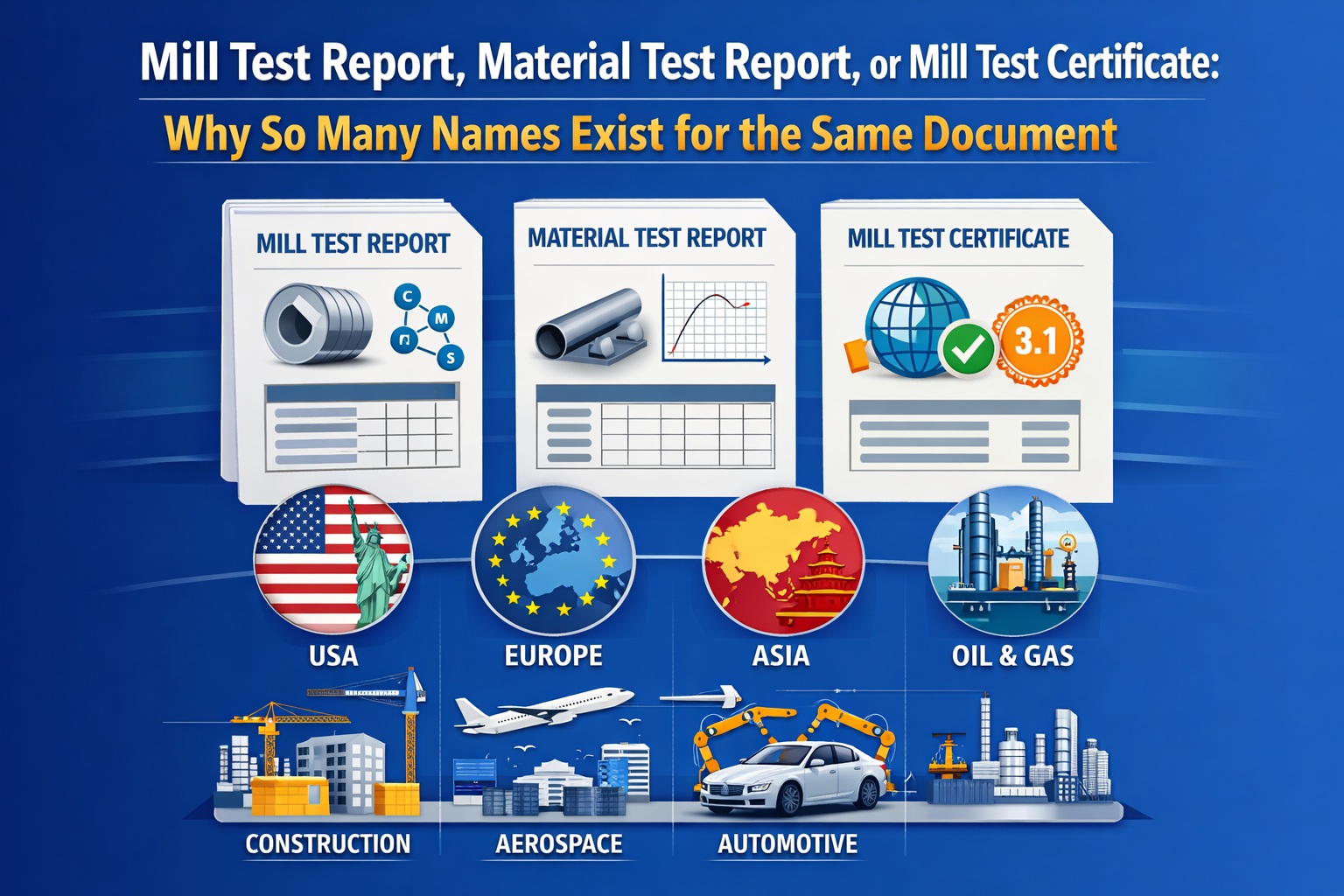
Why So Many Names Exist for the Same Document
The different names largely evolved due to regional terminology and historical industry practices.
Over time, these naming conventions became embedded in procurement systems, contracts, and engineering specifications.
As global supply chains expanded, the terminology began overlapping.
Today, companies often treat the terms as equivalent.
However, subtle differences remain depending on regional standards and industry norms.
Geographic Differences in Terminology
United States
In the United States, the most common terms are:
Mill Test Report (MTR)
Material Test Report
Industries following ASTM and ASME standards typically use the term MTR.
This terminology is widely used in:
Steel manufacturing
Oil and gas
Infrastructure
Energy
Heavy equipment manufacturing
Europe
European industries often use the term:
Mill Test Certificate (MTC)
This usage aligns with EN standards, particularly EN 10204.
Common industries include:
Structural steel
Industrial equipment manufacturing
Pressure vessels
Automotive manufacturing
Middle East
The Middle East largely follows European certification practices, so the term MTC is commonly used in procurement documents.
Industries include:
Oil and gas
Petrochemicals
Infrastructure
Construction
Because of strict compliance requirements in energy projects, material certification documentation is mandatory.
Asia
In Asia, the terminology varies depending on the country.
Common terms include:
MTR
MTC
Test Certificate
Countries with strong steel manufacturing industries such as India, China, Japan, and South Korea typically use all three terms depending on the context.
In procurement documentation, the terms are frequently used interchangeably.
Industries That Depend on MTRs and Test Certificates
Material certification is critical in industries where product failure can lead to safety risks, financial loss, or regulatory violations.
Key industries include:
Oil and Gas
Pipelines, valves, and pressure vessels must meet strict material standards.
Mill test reports verify that the materials used can withstand extreme pressure and corrosive environments.
Construction and Infrastructure
Structural steel used in bridges, buildings, and transportation infrastructure must comply with engineering specifications.
MTRs provide proof that the material meets design requirements.
Aerospace
Aircraft components require extremely precise material specifications.
Certification documents ensure traceability and compliance with aviation safety regulations.
Automotive Manufacturing
Automotive components require consistent material properties to ensure performance and safety.
Material test reports help maintain quality across large production volumes.
Pharmaceuticals and Food Processing
Equipment used in pharmaceutical and food manufacturing often uses stainless steel with strict purity standards.
Material test reports confirm that the materials used comply with regulatory requirements.
The Role of Traceability in Material Certification
One of the most important functions of MTRs is traceability.
Traceability ensures that materials can be linked back to their original production batch.
This is typically done through the heat number.
If a defect is discovered in a product, the heat number allows manufacturers to:
Identify affected batches
Trace the source of the material
Conduct recalls or corrective actions
Without traceability documentation, managing quality and safety risks becomes extremely difficult.
Challenges with Manual Processing of MTRs
Although these documents are critical, they are often complex and inconsistent in format.
Different mills produce reports in different layouts, making manual review difficult.
Organizations handling large volumes of MTRs often face challenges such as:
Manual data entry
Non-standard document formats
Verification errors
Slow quality assurance workflows
Difficulty integrating data into ERP systems
For manufacturers and distributors handling thousands of certificates, these challenges can significantly slow operations.
The Growing Importance of MTR Automation
As supply chains digitize, companies are increasingly adopting AI-powered document processing technologies to automate the extraction and verification of MTR data.
Automation platforms can:
Extract chemical composition data
Capture mechanical properties
Identify heat numbers and material grades
Convert PDFs into structured data
Integrate results into ERP or quality systems
This allows organizations to process large volumes of material certifications quickly while maintaining accuracy and compliance.
——————————————-
Although terms like Test Certificate, Mill Test Report, Material Test Report, and Mill Test Certificate may sound different, they all serve the same fundamental purpose: verifying that materials meet required standards.
The differences largely reflect regional terminology, historical standards, and industry practices.
For organizations operating in global supply chains, understanding these terms—and managing the documentation associated with them—is essential for ensuring quality, compliance, and traceability.
As manufacturing becomes more digital and data-driven, the ability to efficiently process and analyze these certification documents is becoming an increasingly important capability for modern industrial enterprises.