Global manufacturers face growing pressure to prove material compliance, and Material Test Reports (MTRs) are central to that mission—ensuring product integrity, traceability, and audit readiness.
For U.S.-based manufacturers and suppliers in industries like metals, aerospace, automotive, and construction, adhering to ASTM, EN, and ISO standards is not just good practice—it’s a market requirement.
Yet, many companies still rely on manual or semi-digital MTR handling processes, which are prone to errors, inconsistencies, and non-compliance risks. As compliance demands grow more stringent, MTR automation is emerging as a strategic advantage.
This article explores how automating your MTR workflows strengthens compliance, streamlines audits, and opens doors to international markets.
The Compliance Challenge: More Standards, More Scrutiny
Manufacturers today must align with:
ASTM standards for material and product properties in the U.S.
EN standards for conformity in European markets.
ISO standards for global quality management and traceability.
Each requires strict documentation of chemical composition, mechanical properties, heat numbers, and batch traceability. Manual processes—scanning, emailing, re-keying—make it hard to maintain consistent, audit-ready reports.
How MTR Automation Ensures Compliance
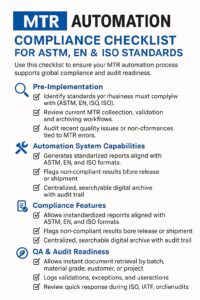
One of the first advantages of MTR automation is standardized formatting. Automated systems produce MTRs that consistently follow the required layout and structure for ASTM, EN, and ISO standards. This reduces the likelihood of rejections by customers or regulatory bodies due to inconsistent or incorrect documentation.
Next, MTR automation eliminates human error by accurately capturing data using Optical Character Recognition (OCR) and Natural Language Processing (NLP). These technologies extract test values such as tensile strength, hardness, or chemical analysis from varied document formats—whether PDF, scan, or image—with precision. This accuracy is essential for maintaining data integrity during audits or quality investigations.
Automation also strengthens traceability. Every automated MTR can be linked to corresponding heat numbers, batch codes, and shipment records in your ERP or quality management system. This traceability not only fulfills ISO 9001 and ASTM traceability requirements but also enables faster material recall or investigation in the event of a non-conformance.
Moreover, automated systems allow you to define validation rules based on specific compliance thresholds. For example, if the carbon content in a sample exceeds ASTM A36 limits, the system immediately flags the issue and alerts the quality team. This kind of real-time exception management is difficult to achieve with manual checks and helps prevent non-compliant materials from moving forward in the production or shipping process.
MTR automation also builds audit readiness. By storing each report in a searchable digital archive, organized by customer, batch, material grade, or project, your team can retrieve documents instantly during internal or external audits. This dramatically reduces the effort and time required to prepare for ISO 9001, IATF 16949, or EN 10204 audits.
Real-World Impact
Consider a Texas-based steel service center aiming to expand into the European market. By implementing MTR automation, they were able to validate reports against both ASTM and EN specifications and centralize their documentation. The results were compelling: a 43% reduction in non-conformances, a 70% drop in audit preparation time, and a 30% increase in export volume to EU clients.
Compliance is no longer a back-office function—it is a strategic capability. Automating your MTR process is one of the most impactful steps you can take to meet global quality standards, reduce operational risk, and build trust with international partners.
In a regulatory environment where every detail matters, MTR automation gives you the confidence, control, and consistency you need to stay ahead.