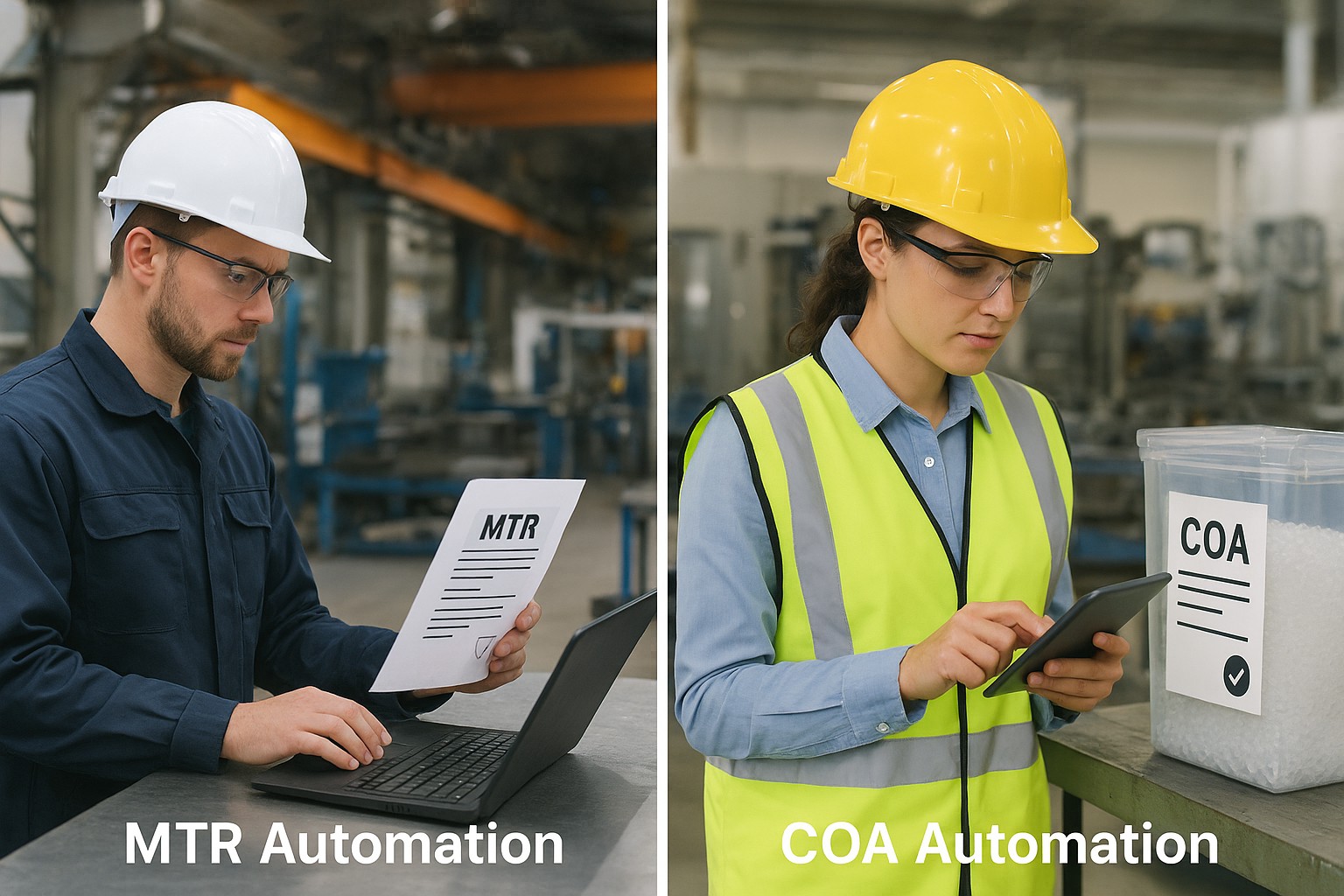
Manufacturers across metals, chemicals, and plastics share one truth: documentation is as critical as the material itself. Two of the most important documents—Mill Test Reports (MTRs) and Certificates of Analysis (COAs)—may sound similar, but they differ in purpose, structure, and compliance implications.
Star Software takes a domain-specific approach, recognizing that a one-size-fits-all automation model won’t work. Here’s how the processes diverge—and why that matters for manufacturers in steel, aluminum, pharmaceuticals, and plastics.
MTR vs. COA: The Key Difference
MTR (Mill Test Report): Predominantly used in metals (steel, alloys, aluminum). It certifies chemical composition and mechanical properties as tested at the mill.
COA (Certificate of Analysis): Used across chemicals, plastics, pharma, and food industries. It certifies that a batch meets specific standards or regulatory limits.
In short:
MTR = Compliance with engineering standards (ASTM, ASME, ISO).
COA = Compliance with quality and safety standards (FDA, EPA, ISO, GMP).
Star Software’s Differentiated Automation Approach
1. MTR Automation Process Flow (Metals Industry)
Process Steps:
Document Capture → MTRs ingested from mills, suppliers, or OEMs (PDFs, scans, structured docs).
Data Extraction → Key fields parsed (heat number, grade, chemical composition, tensile, hardness).
Standards Matching → Automated mapping against ASTM/ASME standards.
Tolerance Validation → Checks for property ranges (e.g., carbon %, tensile strength).
Traceability Linking → Heat number linked to specific lots, purchase orders, and downstream products.
Compliance Report → Auto-generated compliance certificates for customers/regulators.
2. COA Automation Process Flow (Plastics/Pharma/Chemicals)
Process Steps:
Document Capture → COAs received from resin suppliers, labs, or pharma QA.
Data Extraction → Specs like melt flow index, density, additives, heavy metals, active ingredient % parsed.
Regulatory Mapping → Auto-check against FDA 21 CFR (food contact), GMP guidelines, EPA limits, PFAS bans.
Quality Rules Validation → Tolerance checks per SOP (± ranges for viscosity, assay results, microbial limits).
Lot-to-Batch Mapping → Batch-level traceability linked to finished goods.
Audit-Ready Dashboard → Packaged reports for FDA, EPA, or customer audits.
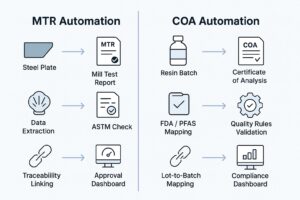
Chart: Comparing MTR vs. COA Automation
| Feature | MTR Automation (Metals) | COA Automation (Plastics/Pharma) |
|---|---|---|
| Industry Focus | Steel, Aluminum, Alloys | Plastics, Chemicals, Pharma, Food |
| Key Data | Heat number, chemical composition, tensile, hardness | Melt flow index, assay %, additives, impurities |
| Standards | ASTM, ASME, ISO | FDA 21 CFR, GMP, EPA, ISO, REACH |
| Traceability | Heat-to-lot, purchase order linkage | Batch-to-finished product linkage |
| Compliance Pressure | Engineering & safety standards | Regulatory, safety, and environmental norms |
| Star’s Differentiation | Heat-number based traceability graph | Multi-regulatory rules engine + ESG reporting |
Why Star Software’s Approach Matters
No one-size-fits-all: A metals manufacturer needs ASTM compliance; a pharma plant needs FDA-ready dossiers. Star Software’s automation adapts to both.
End-to-end traceability: Heat numbers in metals or batch IDs in pharma—both are linked across ERP/QMS systems.
Audit readiness: Whether it’s a customer audit in aerospace metals or an FDA inspection in pharma plastics, compliance packs are generated instantly.
Sustainability edge: In plastics, COA automation supports PFAS bans and recyclability claims; in metals, MTR automation supports ESG-linked steel supply chain audits.
MTRs and COAs may seem like paperwork, but they are the passport of trust in manufacturing. By differentiating how each is automated, Star Software ensures accuracy, compliance, and efficiency across industries—helping U.S. manufacturers build not just stronger products, but also stronger reputations.