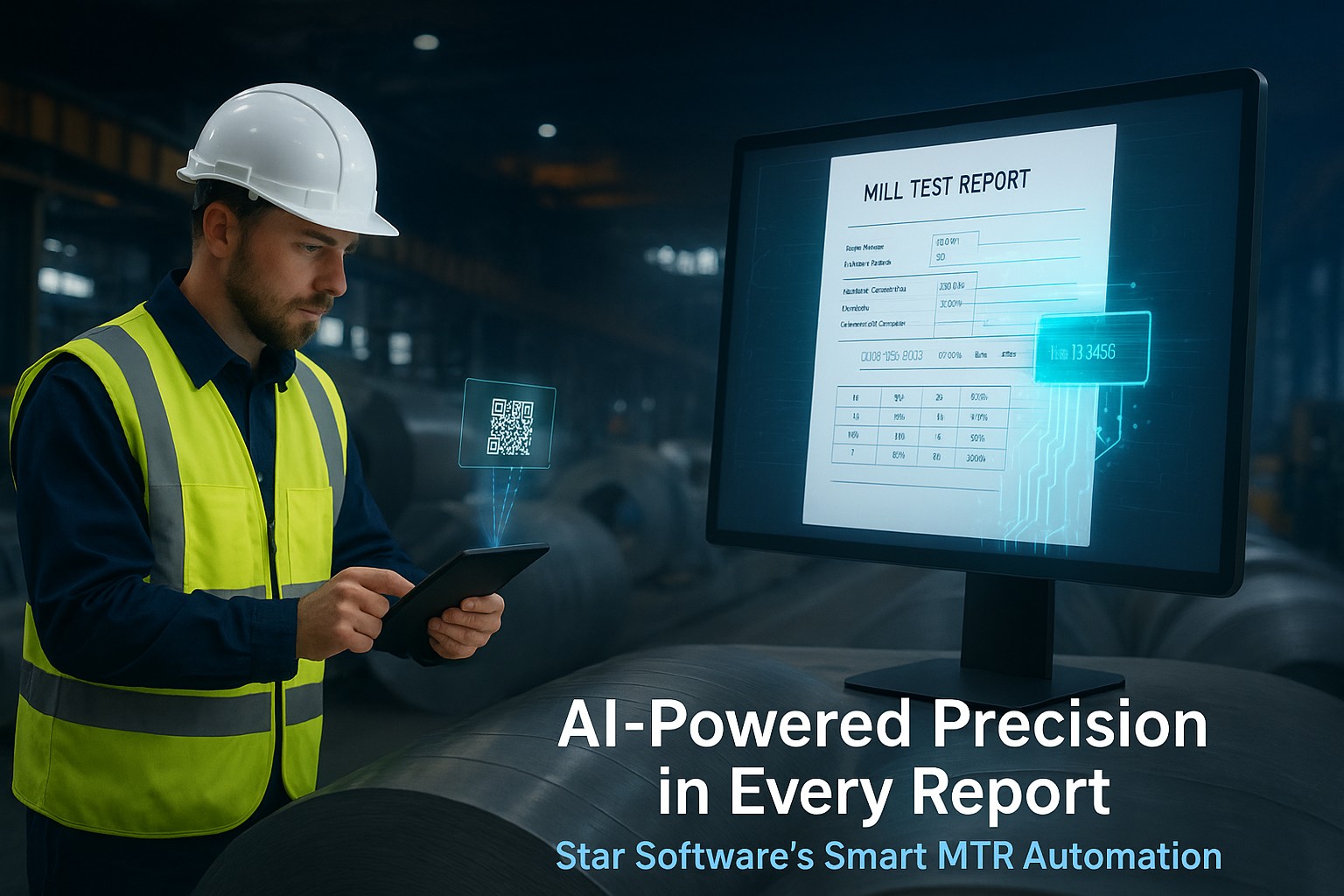
Mill Test Reports (MTRs) sit at the heart of this precision-driven ecosystem — serving as the “birth certificate” of every metal product.
Star Software’s AI-powered automation platform, Star Automation, is transforming how manufacturers, distributors, and fabricators manage their MTR workflows. By integrating OCR, AI, and intelligent data validation, the platform not only extracts data but also ensures accuracy, compliance, and traceability — customized to the needs of each client.
The Core of MTR Automation
An MTR contains crucial data points such as Heat Number, Material Grade, Chemical Composition, Mechanical Properties, and Manufacturer Information. Traditionally, these reports have been reviewed manually, often involving hours of cross-verification. Star Automation changes that by introducing an intelligent data extraction process that captures and validates every field with unmatched precision.
Its capabilities go beyond simple OCR reading. Star Automation maps data intelligently into structured formats like Quality Data Sheets (QDS), cross-checks the extracted information with original certificates, and identifies missing or mismatched values in real time. The result — error-free, validated data ready for quality assurance and ERP integration.
Customized MTR Solutions: Real Test Case Scenarios
Star Software’s strength lies in its customized approach to MTR automation. Each client has unique workflows, document formats, and data priorities — and Star adapts seamlessly to them.
Take the Dover Star MTR AI Engine, for example. The system automatically validates document flow from certificate drop to QDS creation. Once an MTR is uploaded to the designated Google Drive folder, the AI engine triggers extraction, runs validation checks on Heat Number, Purchase Order, and Item details, and sends automated pass/fail email notifications. It even detects pre-receiving entries — ensuring every MTR is processed, validated, and communicated without human follow-up.
Another instance is Basic Metals, where Star Automation accurately extracts both chemistry and mechanical data, verifying them against the source certificate. The process ensures full alignment between the manufacturer’s certification and the customer’s quality standards.
For Flack Metals, the focus was on traceability. The test case required validation of Coil and Heat Numbers as mandatory fields. Star’s extraction model automatically recognized these identifiers, populated them accurately, and created Excel-based summaries for Chemistry, Mechanical, and Coil-Heat data — ensuring no material batch was left untracked.
With Three D Metals, the challenge was unit-based mapping. Mechanical parameters like tensile strength were represented differently depending on the measurement system (ksi or MPa). The AI model adapted dynamically, mapping parameter names and values correctly to their respective units, ensuring flawless mechanical data validation.
Triple S Star presented a document complexity challenge — multi-page TIFF files. Star Automation not only processed these but also converted and extracted data across all pages, validating Heat, PO, Mill Name, and Certificate Numbers accurately.
In Lewis Brass, the customer had specific business rules — trimmed Heat Numbers had to be ignored. Star Automation’s logic was fine-tuned to those rules, ensuring the generated certificates matched customer expectations and Sales Order references.
Every one of these cases demonstrates how Star Software doesn’t just automate MTR extraction — it customizes intelligence to align with the customer’s operational and compliance framework.
Scaling Up: The Ferguson Experience
For large-scale operations like Ferguson, automation must balance speed with system-wide accuracy. Star Automation is built to scale, handling multi-vendor, multi-format MTR packets while maintaining complete data integrity.
In Ferguson’s deployment, suppliers upload MTR packets directly to the system. The AI engine distinguishes whether the documents belong to a single vendor or multiple vendors. It then automatically splits, indexes, and assigns them correctly using certificate numbers — a process that would otherwise take hours of manual sorting.
The system also supports QR code integration, linking physical shipments to their digital MTRs. When a QR code printed on a package or pallet is scanned, the corresponding MTR PDF opens instantly — simplifying traceability for logistics and customers alike.
Another layer of intelligence is visible in Star’s search and access management features. Ferguson’s users can search by PO number, Heat Number, Description, or even partial keywords — thanks to an AI-driven OCR filter that accounts for typographical variations and scanned document inconsistencies. The system also ensures role-based access, allowing MTR clerks, supervisors, and customers to interact with data securely within their access level.
During data migration, Star’s automation mapped legacy MTRs from Excel, CSV, and PDF formats into the new database — retaining metadata, linking files, and verifying every Heat and PO Number. This seamless transition ensured Ferguson retained its complete MTR history, now searchable and actionable.
Beyond Extraction: Validation, Traceability, and Insight
Star Software’s MTR automation isn’t limited to data extraction; it’s about building a connected intelligence layer across operations. The system detects missing or inconsistent data, prompts for human verification when confidence scores fall below threshold levels, and maintains version control for every validated MTR.
Moreover, the platform supports direct digital sharing — allowing customers to email MTRs or Packing Slips without printing, reducing paper dependency and turnaround time. Every shared document is traceable, timestamped, and stored securely.
This end-to-end traceability helps companies meet compliance with ASTM, ASME, and ISO standards while strengthening their internal quality management systems.
A Smarter Way to Handle MTRs
What truly differentiates Star Software is its philosophy of intelligent customization. Each implementation reflects a blend of AI precision and business-specific adaptation — whether it’s Dover’s automated validation, Flack’s traceability logic, or Ferguson’s large-scale data migration.
By bridging the gap between document data and operational systems, Star Automation is redefining how manufacturers view MTR management — from a manual, error-prone task to a strategic, automated process that fuels accuracy, compliance, and customer trust.
Star Software’s MTR automation doesn’t just read data — it understands it.