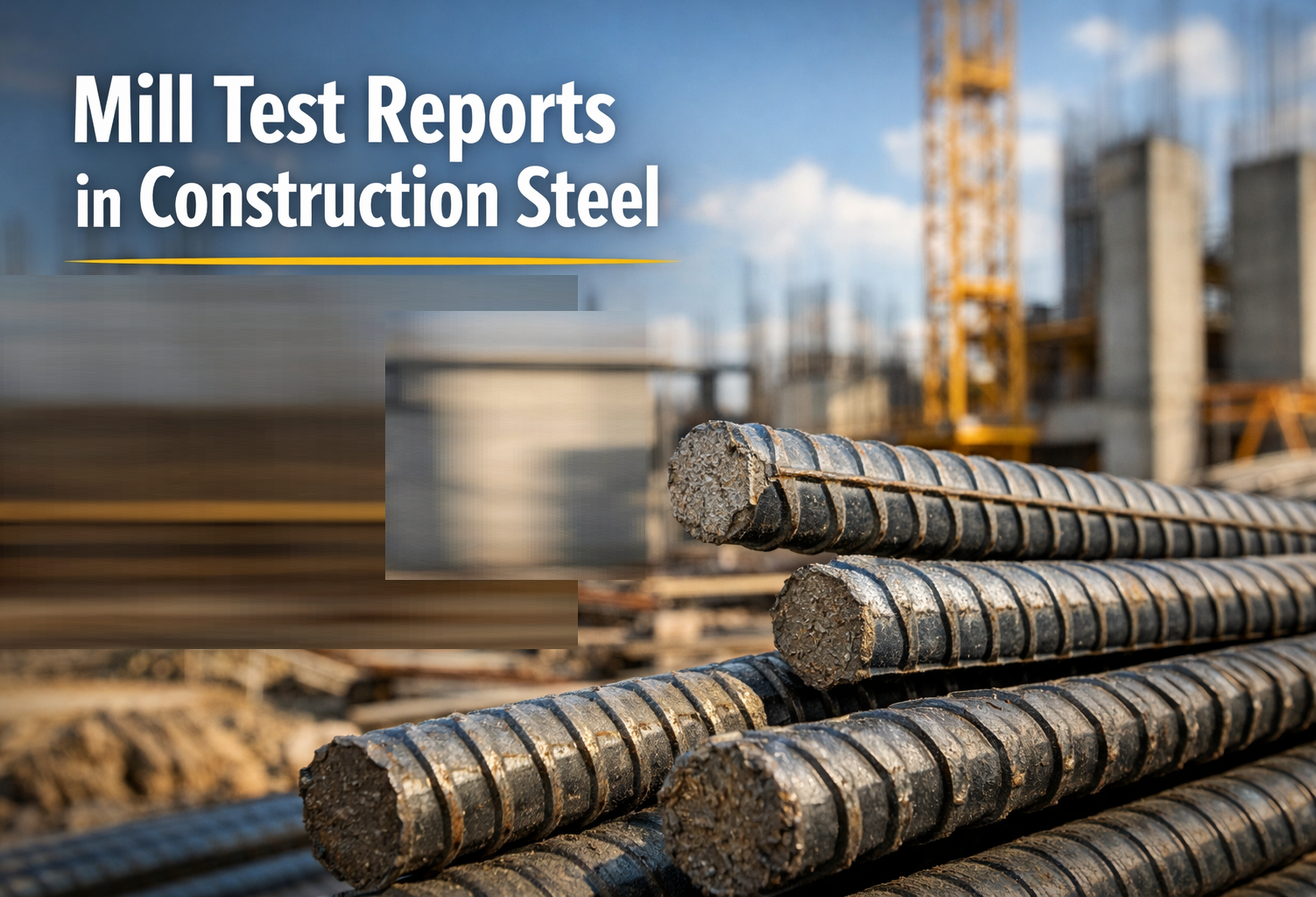
Walk onto any large construction site—a bridge project, a high-rise tower, or a metro rail corridor—and you’ll see steel everywhere. Beams, columns, rebars, plates. What you won’t see, but what quietly governs the safety and integrity of everything built, is a document called the Mill Test Report (MTR) or Mill Test Certificates (MTC).
For engineers, contractors, and procurement teams, MTRs are not paperwork—they are proof. Proof that the steel being used will perform as expected, withstand loads, and meet regulatory standards.
This article breaks down how MTRs function in construction steel, why they are critical, and where things can go wrong without proper verification.
What is an MTR/MTC in Construction Steel?
A Mill Test Report (MTR) or MTC in construction is a document issued by the steel manufacturer that certifies the material’s chemical composition and mechanical properties.
In simple terms, it answers a fundamental question:
“Is this steel actually what it claims to be?”
Every batch of steel produced in a mill is assigned a heat number—a unique identifier that links the final product back to its origin. The MTR captures all relevant test data associated with that batch.
For construction projects, this becomes essential because structural safety depends entirely on material performance.
What Does an MTR Contain for Construction Steel?
While formats vary across mills, most MTRs used in construction include the following:
1. Heat Number (Traceability Backbone)
This is the most critical element. It allows engineers to trace the steel back to the exact batch it was produced from.
If a defect is found later, the heat number helps identify all affected materials.
2. Material Grade
The MTR specifies the steel grade—such as:
- ASTM A36
- ASTM A572
- IS 2062
- EN S355
Each grade has defined strength and composition standards used in structural design.
3. Chemical Composition
This section lists the percentage of elements like:
- Carbon
- Manganese
- Silicon
- Sulfur
- Phosphorus
Even small variations can impact weldability, ductility, and corrosion resistance.
4. Mechanical Properties
This is where performance is validated:
- Yield strength (how much load steel can take before deforming)
- Tensile strength (maximum load before breaking)
- Elongation (ductility)
- Impact strength (resistance to sudden force)
These values must match the design specifications used by structural engineers.
5. Testing Standards
The report confirms compliance with standards such as:
- ASTM
- EN
- IS
- ISO
These standards ensure consistency across global construction practices.
Why MTRs Are Critical in Construction Projects
In construction, there is very little margin for error. Steel failure is not just a quality issue—it’s a safety risk.
Here’s why MTRs are indispensable:
1. Structural Integrity
Every beam and column in a structure is designed based on assumed material properties.
If the steel does not meet those properties, the structure may:
- Deform under load
- Crack under stress
- Fail prematurely
MTRs confirm that the steel matches design assumptions.
2. Regulatory Compliance
Construction projects must comply with building codes and standards.
Regulatory authorities often require:
- Verified material certifications
- Inspection records
- Traceability documentation
Without valid MTRs, projects can face delays, penalties, or rejection.
3. Quality Assurance in Procurement
Construction supply chains are complex.
Steel may pass through:
- Mills
- Distributors
- Fabricators
- Contractors
At each stage, the risk of material substitution or mislabeling exists.
MTRs act as a checkpoint to verify authenticity.
4. Traceability and Risk Management
If a defect is discovered—say, cracks in a batch of beams—the heat number allows teams to:
- Trace affected materials
- Isolate impacted structures
- Take corrective action
Without traceability, the entire project may be at risk.
Real-World Scenario: Where MTRs Make the Difference
Consider a mid-sized infrastructure project where structural steel is sourced from multiple suppliers.
During inspection, engineers notice inconsistencies in weld performance. Upon reviewing the MTRs, they discover:
- One batch has slightly higher carbon content
- Another batch falls short on yield strength
Because the MTRs were available and properly verified, the issue is caught early.
The affected materials are replaced before installation.
Without MTR verification, the same issue could have resulted in structural weakness after project completion, leading to costly repairs—or worse.
Common Challenges with MTRs in Construction
Despite their importance, MTRs are not always easy to manage.
1. Non-Standard Formats
Different mills use different templates, making it difficult to interpret data consistently.
2. Manual Verification
Engineers often review MTRs manually, comparing values against specifications.
This is:
- Time-consuming
- Error-prone
- Not scalable for large projects
3. Volume of Documents
Large construction projects may involve thousands of MTRs.
Managing them manually slows down quality control processes.
4. Risk of Errors
Even a small mistake—like misreading a tensile strength value—can have serious consequences.
The Shift Toward Digital and Automated MTR Processing
As construction projects become larger and more complex, companies are moving toward digital solutions for MTR management.
Modern approaches include:
- Digitizing MTR documents
- Extracting data automatically using AI
- Validating material properties against specifications
- Integrating data into ERP and quality systems
This shift is helping construction companies:
- Reduce verification time
- Improve accuracy
- Strengthen compliance
- Enable faster decision-making
How MTRs Fit into the Future of Construction
The construction industry is gradually adopting data-driven practices.
MTRs, once treated as static documents, are now becoming structured data assets.
This opens up new possibilities:
- Real-time material verification
- Predictive quality analysis
- Integrated supply chain visibility
- Better audit readiness
In the coming years, companies that treat MTRs as data—not just documents—will have a clear advantage.
In construction steel, the importance of Mill Test Reports cannot be overstated.
They ensure that materials meet the required standards, support structural integrity, and provide traceability across the supply chain.
While the document itself may seem routine, its impact is anything but.
For engineers and project managers, MTRs are a silent safeguard—ensuring that what gets built today will stand strong for decades.
Related FAQs:
What is a Mill Test Report (MTR) in construction steel?
A Mill Test Report (MTR) is a document issued by the steel manufacturer that certifies the chemical composition and mechanical properties of construction steel, ensuring it meets required standards.
2. Why are MTRs important in construction projects?
MTRs ensure structural integrity, regulatory compliance, and material traceability, helping engineers verify that steel meets design and safety requirements.
3. What is a heat number in an MTR?
A heat number is a unique identifier assigned to a batch of steel, enabling full traceability from the final product back to its production process.
4. What information does an MTR contain?
An MTR typically includes material grade, chemical composition, mechanical properties, heat number, testing standards, and certification details.
5. How do MTRs ensure quality in construction steel?
MTRs validate that the steel meets required specifications, helping prevent material failure, ensuring safety, and supporting quality assurance processes.
6. Are MTRs mandatory in construction projects?
In many regulated industries and infrastructure projects, MTRs are mandatory to meet compliance, safety, and audit requirements.
7. What are the challenges of managing MTRs manually?
Manual MTR processing can be time-consuming, error-prone, and difficult to scale due to non-standard formats and large document volumes.
8. How can MTR processing be automated?
MTR automation uses AI to extract, validate, and structure data from reports, improving accuracy, reducing manual effort, and speeding up verification.