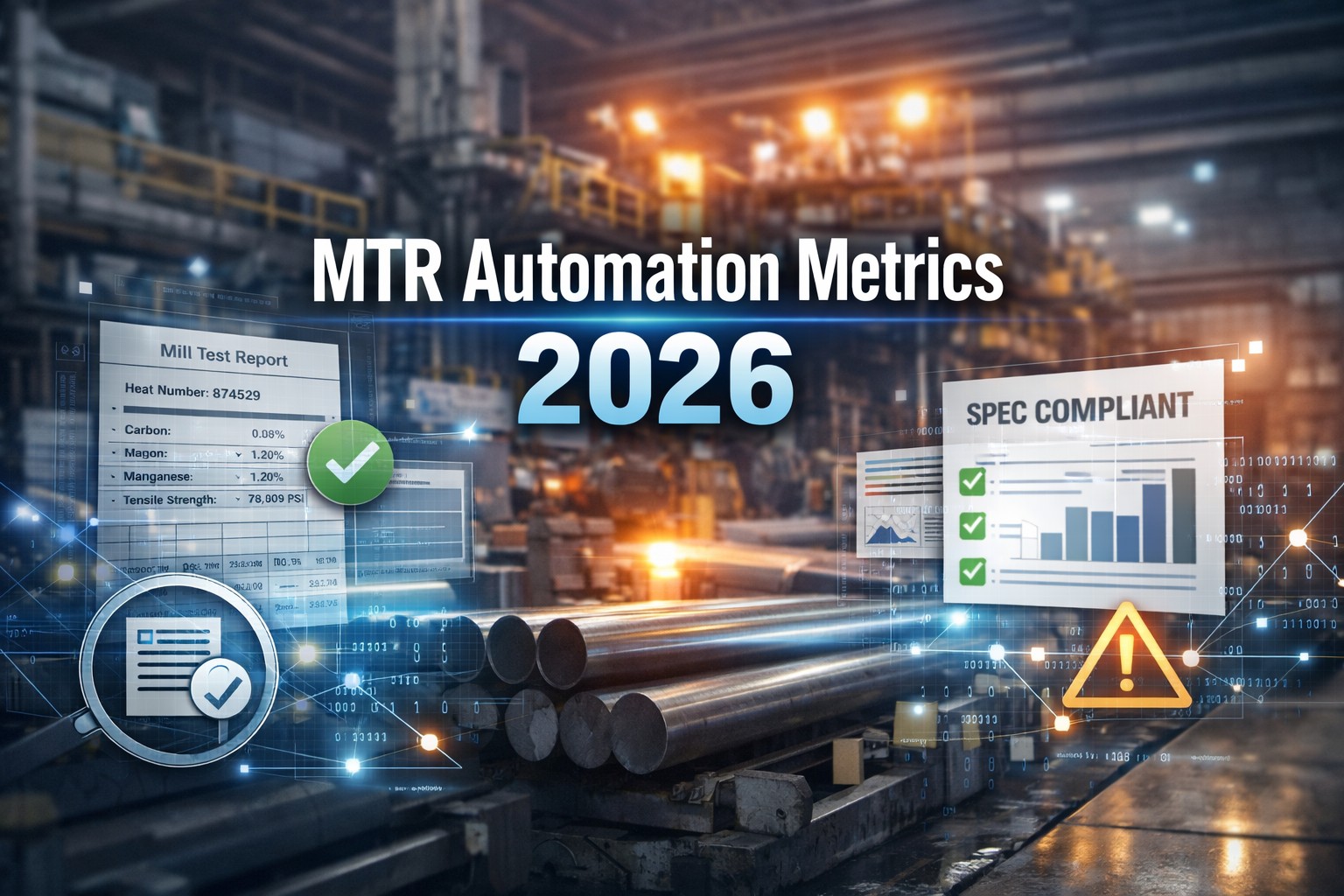
For Quality Heads, Mill Test Report (MTR) automation is no longer judged by how many PDFs were processed. In 2026, its value is measured by how well it protects audit outcomes, supplier integrity, and production continuity. As regulatory scrutiny tightens and supply chains stretch across borders, Quality leaders are redefining success through metrics that demonstrate control—not activity.
Below are the ten MTR automation metrics that truly matter to Quality Heads in 2026.
1. MTR First-Pass Validation Rate
This metric measures the percentage of incoming MTRs that pass specification, heat number, and chemistry checks without manual intervention. A high first-pass rate signals that automation logic is mature and supplier data quality is stable. Quality Heads track this closely because it directly reflects how often QA teams are forced into exception handling.
2. Specification Match Accuracy
Beyond data extraction accuracy, this metric evaluates how reliably MTR values align with ASTM, ASME, or customer-specific material specifications. In 2026, auditors increasingly test whether systems can automatically flag borderline or out-of-range values. Quality leaders see this as a proxy for audit defensibility.
3. Exception Resolution Turnaround Time
When MTR discrepancies occur, the speed at which they are resolved determines whether production halts or continues. This metric tracks the time from exception detection to final disposition. In high-volume environments, even small delays compound into shipment risks—making this a board-level concern in regulated industries.
4. Supplier MTR Error Rate
Quality Heads are shifting focus from internal QA performance to upstream supplier behavior. This metric identifies suppliers with recurring MTR inconsistencies, missing fields, or formatting anomalies. In 2026, it is increasingly used to drive supplier scorecards and corrective action programs.
5. Audit Traceability Coverage
This measures the percentage of MTRs that are fully traceable—linked to purchase orders, heat numbers, production lots, and shipments. During audits, partial traceability is often worse than failure. Quality leaders value this metric because it demonstrates system-level governance, not individual diligence.
6. Manual Touchpoint Reduction Rate
Manual handling introduces risk, variability, and undocumented decision-making. This metric tracks how much human intervention has been eliminated from MTR processing workflows. In 2026, Quality Heads correlate this directly with reduced audit findings and improved data integrity.
7. MTR Processing Cycle Time
From receipt to approval, cycle time reflects how well automation integrates with ERP, QMS, and supplier portals. Faster cycles improve production planning and supplier onboarding, but Quality leaders focus on consistency—not just speed—to ensure controls are not bypassed.
8. Data Integrity Violation Incidents
This metric captures instances of altered files, overwritten values, missing version histories, or broken approval chains. With regulators emphasizing data integrity across industries, Quality Heads treat this as a non-negotiable metric tied to enterprise risk management.
9. Compliance Rule Coverage Ratio
Not all automation platforms enforce the same depth of rules. This metric evaluates how many applicable standards—ASTM, ISO, AS9100, IATF, customer specs—are actively governed by the system. In 2026, Quality leaders expect automation to adapt as regulations evolve, not require reconfiguration projects.
10. Audit Observation Rate Linked to MTRs
Ultimately, Quality automation is judged in the audit room. This metric tracks how often MTR-related issues appear in internal or external audit observations. A declining trend is the strongest signal that MTR automation is functioning as a quality evidence control—not a document handling tool.
Why These Metrics Redefine Quality Leadership in 2026
Quality Heads are no longer evaluated on inspection rigor alone. They are accountable for evidence governance, supplier reliability, and audit resilience. MTR automation, when measured correctly, becomes a strategic control layer—reducing risk before it reaches production or regulators.
In 2026, the question is no longer “Do we automate MTRs?”
It is “Can we prove our quality system is in control—at scale?”