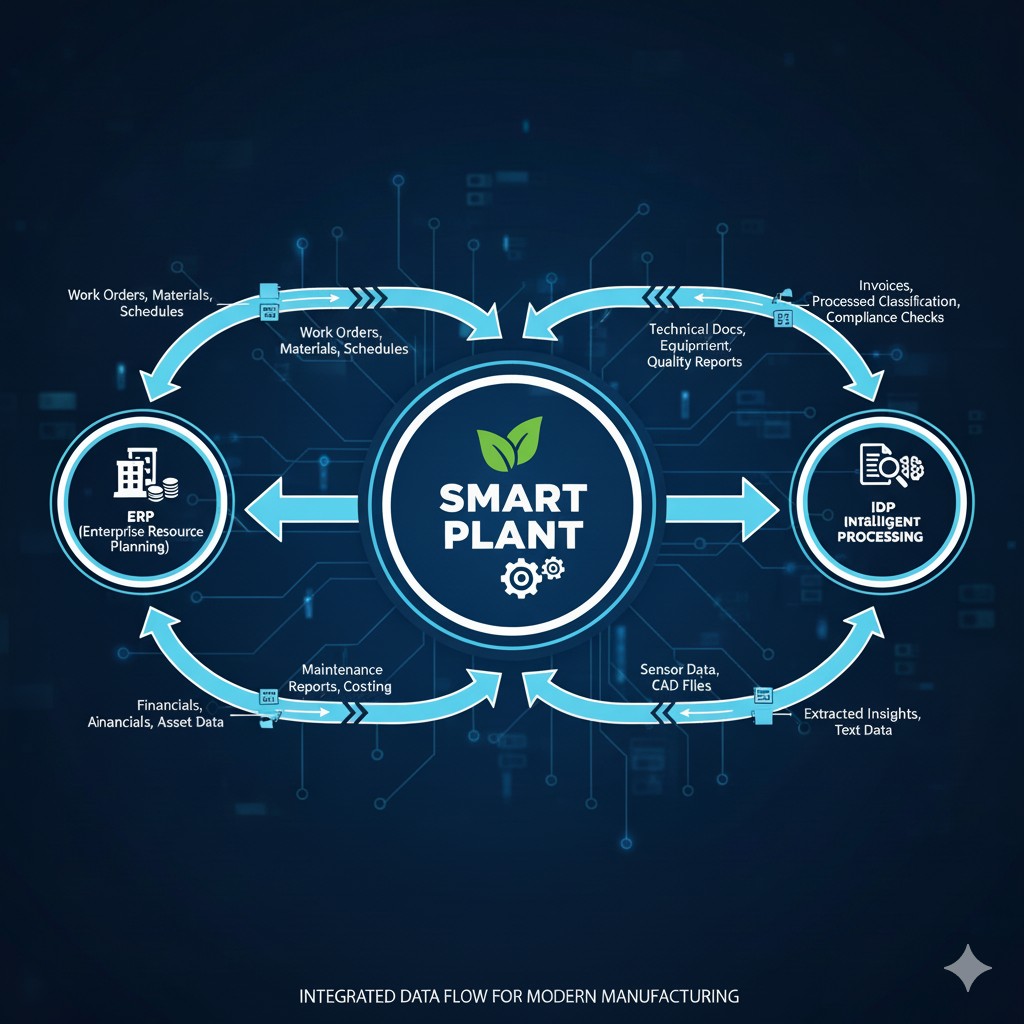
Industry 4.0 is revolutionizing how factories operate, bringing IoT, AI, and predictive analytics into daily workflows. Smart plants are already producing mountains of operational data—from equipment uptime to energy consumption and quality metrics. But the real value of this data emerges only when it is seamlessly integrated with financial systems inside ERP platforms.
Here’s the catch: before data even reaches ERP or smart-plant systems, it often originates in unstructured documents like invoices, supplier COAs, or MTRs. This is where Intelligent Document Processing (IDP) plays a vital role. Together, ERP, smart plant, and IDP automation form a closed-loop ecosystem that makes real-time decisioning possible.
Why Integration Across ERP, Smart Plant, and IDP Matters
Real-Time Cost Visibility
A smart plant can measure raw material usage per batch, but without ERP alignment you can’t translate that into real-time cost per unit. With IDP, supplier invoices and COAs are digitized, validated, and synced directly into ERP. The result: operations data combines with financial insights to deliver a true picture of profitability.Faster, Data-Driven Decisions
Market volatility—like aluminum price swings or pharmaceutical API shortages—demands instant responses. IDP ensures financial documents flow into ERP in near real-time, while the smart plant provides operational metrics. This combined data enables leaders to reallocate budgets, optimize sourcing, or shift production lines within hours, not weeks.Predictive Maintenance with Financial Context
IoT sensors may predict a pump failure in a steel plant. When this alert is linked with ERP and IDP-fed procurement data, managers can instantly weigh costs: is it cheaper to repair, replace, or reroute production? The decision is no longer just operational—it’s financially intelligent.Regulatory & Compliance Edge
Industries like pharma and metals face strict compliance standards. A COA scanned through IDP feeds quality and compliance data directly into ERP. Combined with operational logs from the smart plant, companies maintain a single, audit-ready system of truth, reducing compliance risks and manual reconciliations.
The Industry 4.0 Imperative
A 2023 Deloitte survey found that 73% of manufacturers are investing in tighter integration between ERP and plant-floor systems. Add IDP to the mix, and the benefits grow: McKinsey estimates that automated document processing reduces manual quality checks by up to 70%, freeing teams for higher-value tasks.
Another PwC report noted that manufacturers with ERP–operations–IDP integration achieved 15% EBITDA improvement through efficiency, agility, and compliance gains.
What Happens Without Integration
Finance teams rely on outdated, incomplete, or error-prone document data.
Operations make siloed decisions without financial context.
Compliance teams scramble to reconcile mismatched records.
Leaders lose agility when real-time pivots are needed most.
Smart plants without ERP, and ERP without IDP, are like engines running without dashboards—you’re moving fast but flying blind.
In Industry 4.0, ERP, smart plants, and IDP are not separate systems—they are three pillars of an intelligent enterprise. Together, they deliver real-time decisioning, financial clarity, and compliance confidence.
The future factory is not only automated—it’s data-driven, financially intelligent, and audit-ready. And that future depends on syncing ERP, smart plants, and IDP into one seamless ecosystem.