
In the pharmaceutical industry, precision isn’t just important—it’s non-negotiable. From batch release to regulatory inspections, every stage of production is governed by strict Good Manufacturing Practices (GMP). Among the most critical documents in this process is the Certificate of Analysis (COA)—a quality assurance report that verifies product compliance with safety and quality standards.
Yet, many pharmaceutical companies still rely on manual methods to verify COAs. While this may have sufficed in the past, today’s regulatory environment, digital compliance mandates, and sheer volume of data make manual COA verification a major liability.
Let’s break down why manual COA handling fails GMP standards—and how automation offers a future-ready solution.
❌ The Problem with Manual COA Verification
1. Human Errors and Inconsistencies
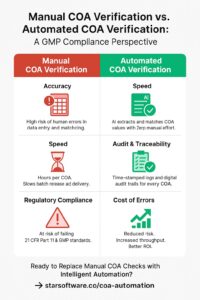
COAs are often received in unstructured formats—PDFs, scanned images, or printed documents. Manually reviewing these documents introduces human error, especially when comparing dozens of parameters across lab systems and supplier data. A single oversight could mean a non-compliant batch reaches the market or a compliant one gets rejected.
2. Delayed Batch Release
Manual verification is time-consuming. QA teams often spend hours per COA cross-checking values against product specifications or material master records. This leads to bottlenecks in batch release, impacting downstream production and delivery timelines.
3. Poor Traceability and Auditability
GMP demands clear, timestamped, and traceable documentation for all quality decisions. Paper-based or spreadsheet-driven processes lack audit trails, making it hard to demonstrate compliance during FDA or MHRA inspections.
4. Compliance Risks with 21 CFR Part 11
Manual COA review processes often bypass electronic recordkeeping standards outlined under 21 CFR Part 11, which governs data integrity, authentication, and electronic signatures. Failing to comply could trigger warning letters or product holds.
✅ The Tech-Driven Fix: COA Automation with AI
At Star Software, we’ve reimagined COA verification through intelligent automation—removing manual friction while enhancing accuracy and compliance.
🔹 Intelligent Document Processing (IDP)
Our system uses AI-powered OCR to extract structured data from unstructured COAs—whether it’s a scanned PDF from a supplier or a digitally signed document. No more manual typing or value-by-value matching.
🔹 Auto-Matching with Product Specs
The extracted data is automatically matched with predefined quality specifications from ERP, LIMS, or MDM systems. Any out-of-spec values or missing data are instantly flagged—reducing decision latency.
🔹 Digital Audit Trails and Validation Logs
Every COA processed generates a secure digital trail, complete with validation logic, user activity logs, and time-stamped approvals—ensuring you’re always audit-ready.
🔹 21 CFR Part 11 and GMP-Ready
The platform supports electronic signatures, access control, and tamper-proof records, aligning with global regulatory requirements for data integrity and electronic documentation.
📈 Real Impact: What Pharma Teams Achieve with COA Automation
Up to 80% reduction in COA processing time
Zero data transcription errors
Audit readiness within seconds
Faster batch release and improved throughput
Better collaboration across QA, procurement, and compliance
👩⚕️ From Risk to Resilience: Future-Proof Your COA Process
As regulators sharpen their focus on data integrity and operational transparency, clinging to manual COA verification is no longer safe—or sustainable. Automation is more than a digital upgrade; it’s a strategic move to align your operations with GMP, accelerate compliance, and safeguard product quality.
Explore how Star Software’s COA Automation platform can future-proof your pharma operations.
Schedule a free demo