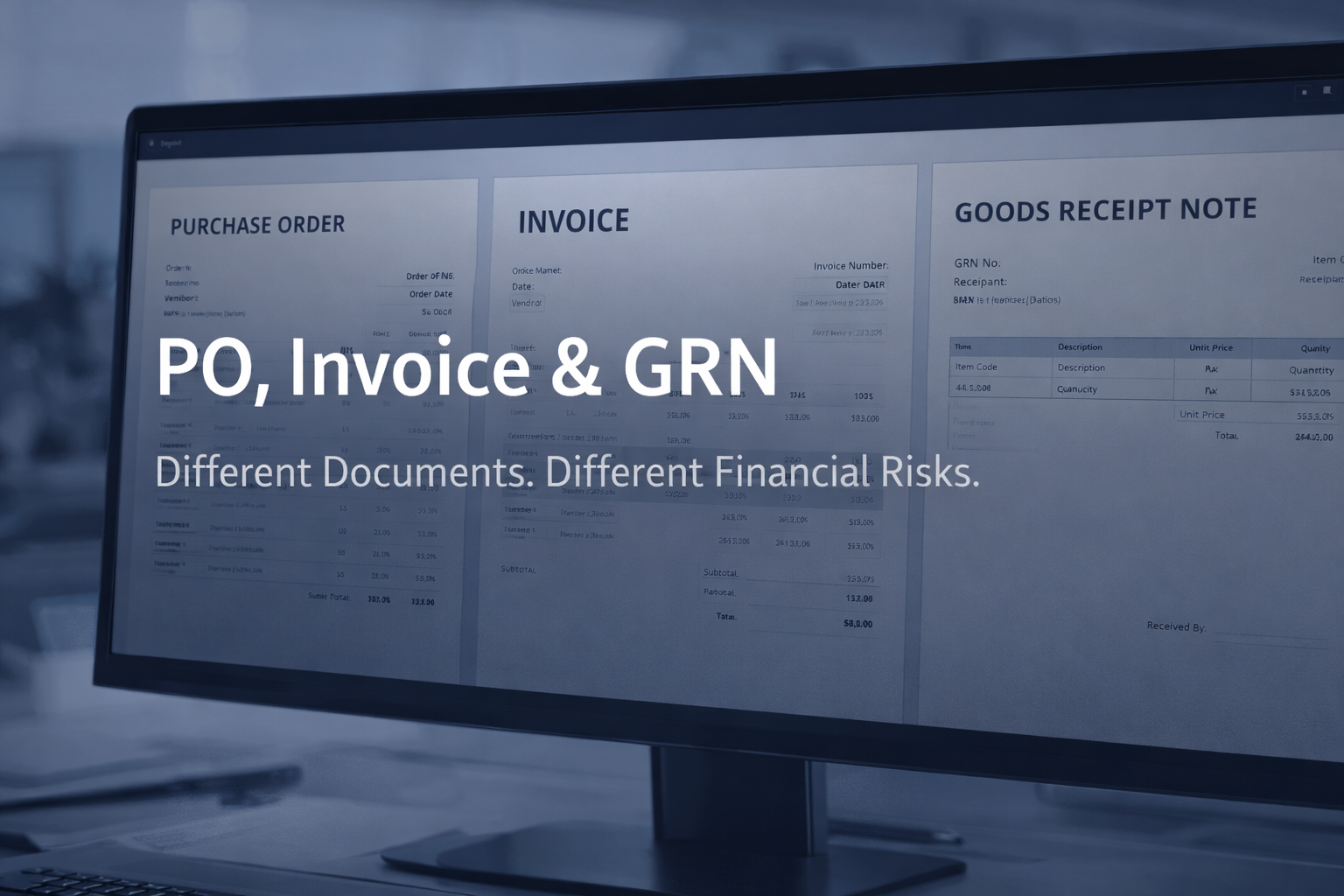
For finance teams, document processing is not a back-office routine—it is the backbone of financial control, compliance, and cash flow discipline. Yet, Purchase Orders (POs), Invoices, Goods Receipt Notes (GRNs), and allied documents are often treated as similar inputs in a single workflow. In reality, each document serves a distinct business purpose, carries unique risks, and demands a different level of scrutiny.
Understanding these differences is critical—especially as organizations scale, operate across geographies, or move toward automation.
1. Purchase Orders (PO): The Financial Contract Before the Spend
What makes POs unique
A PO is not just a document—it is a financial commitment. Once approved, it sets the legal, commercial, and budgetary boundaries for a transaction.
Key challenges in PO processing
Data consistency: Vendor details, item descriptions, quantities, pricing, tax codes, delivery terms
Version control: Amendments, partial cancellations, or revised quantities often lead to confusion
Approval integrity: Unauthorized or bypassed approvals can expose the organization to unplanned spend
What finance must scrutinize
Alignment with approved budgets and cost centers
Correct pricing, discounts, and tax applicability
Valid authorization as per delegation-of-authority matrix
Risk if missed: Budget leakage, contract disputes, and weak spend governance.
2. Invoices: Where Errors Directly Hit Cash Flow
Why invoices are the most sensitive document
Invoices are payment triggers. Any error here immediately affects cash flow, vendor relationships, and audit outcomes.
Key challenges in invoice processing
Format variability: PDF, scanned copies, e-invoices, emails, handwritten notes
Vendor inconsistencies: Different naming conventions, line-item structures, tax treatments
Duplicate risk: Same invoice submitted multiple times across channels
What finance must scrutinize
Invoice number, date, and vendor identity
Tax breakdowns (GST/VAT/TDS), currency, and totals
PO reference and line-level matching
Payment terms and due dates
Risk if missed: Overpayments, tax non-compliance, delayed closes, and audit flags.
3. Goods Receipt Notes (GRN): Proof That Value Was Delivered
Why GRNs are often underestimated
GRNs bridge operations and finance. They confirm that goods—or services—were actually received, not just ordered or billed.
Key challenges in GRN processing
Operational dependency: Data often comes from warehouses or site teams, not finance
Partial receipts: Split deliveries complicate matching
Timing gaps: GRN created days or weeks after physical receipt
What finance must scrutinize
Quantity received vs quantity ordered
Date of receipt vs invoice date
Acceptance or rejection status
Location and storage references
Risk if missed: Paying for undelivered goods, inventory misstatements, weak internal controls.
4. The Three-Way Match: Where Complexity Peaks
The true test of document discipline lies in PO–GRN–Invoice matching.
Why it is hard
Line-level mismatches (price, quantity, tax)
Partial deliveries and progressive invoicing
Manual interventions and email-based clarifications
What finance must ensure
Tolerance thresholds are clearly defined
Exceptions are documented and approved
Matching logic is consistent across vendors and categories
Risk if mishandled: Process bottlenecks, payment delays, and strained vendor relationships.
5. Other Critical Finance Documents Often Overlooked
Beyond PO, Invoice, and GRN, finance teams routinely process:
Credit/Debit Notes – Adjustments that must link back to original invoices
Contracts & Rate Cards – Source of truth for pricing validation
Delivery Challans & Proof of Delivery – Supporting evidence during disputes
Tax Certificates & Compliance Forms – Mandatory for audits and statutory reporting
Each of these documents introduces contextual validation, not just data extraction.
| Document | Primary Risk | Nature of Scrutiny |
| PO | Unauthorized spend | Policy & budget control |
| Invoice | Financial loss | Arithmetic, tax, duplication |
| GRN | Paying without receipt | Quantity & timing validation |
| Credit Note | Revenue leakage | Reference & linkage checks |
The Real Shift: From Data Capture to Decision Validation
Modern finance teams are moving from:
“Is the data captured correctly?” To “Does this document make financial sense in context?”
That shift requires:
Document-type-aware processing
Line-level and cross-document validation
Clear exception workflows instead of manual firefighting
For finance leaders, document processing is no longer a transactional problem—it is a control, compliance, and cash-flow problem. POs define intent, GRNs confirm reality, and invoices demand precision. Treating them differently is not optional; it is fundamental to financial excellence.
As volumes grow and audits get stricter, the winners will be finance teams that respect these differences—and design their processes and automation strategies accordingly.